HOME
Soap Bubble Nebula
Soap Bubble Nebula
PN G075.5+01.7
Planetary Nebula in Cygnus
Click here for uncropped and different-resolution versions: 40% (1638x1638) 65%
(2662x2662) 100% (4096x4096)
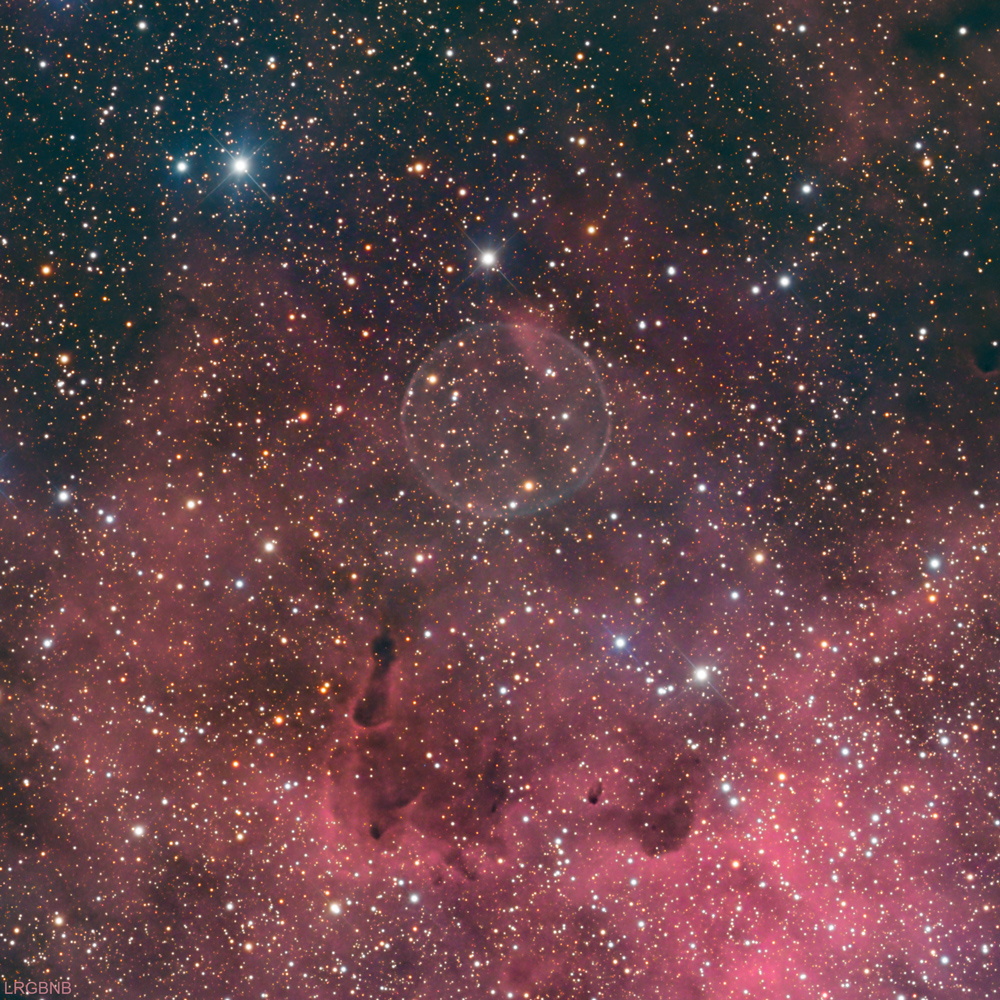 Click on image to cycle through the three versions of the image (described below and labeled on the lower left corner of each image)
Soap Bubble Nebula: This is an extremely dim, largely transparent, planetary nebula, visually located in the
constellation Cygnus; its name comes from the resemblance of the almost-transparent bubble to a soap bubble kids play with. It was only discovered in 2008, at almost the same time,
independently. I believe that the progenitur star is the tiny, bright blue, star at the center of the bubble; it's easy to see in all three versions.
The nebula is estimated to be about 4,700 light years from Earth at that distance, it is roughly 6 light years in diameter.
I have presented this in three different formats (each image is labeled in the lower left corner); this is the order in which they appear as you cycle through (by repeatedly clicking on the photo,
waiting for each to download):
(i) A true-color version, with the color created by imaging through red, green and blue filters (with a significant amount of Ha blended into the red channel and the
luminance layer, and OIII data blended into the green channel, the blue channel, and the luminance layer, in varying percentages);
(ii) A true-color version, with the color created by imaging through red, green and blue filters (with no narrow band data included);
(iii) A bi-color version (almost true-color version; the top photo in the stack), in which red is emissions of ionized hydrogen (Ha), and green and blue are
doubly-ionized oxygen emissions (OIII); this works (giving fairly accurate colors) in this nebula because the vast majority of the
emissions are in Ha or OIII, and Ha is in the red part of the spectrum, while OIII is blue-green. That said, the Ha has been de-emphasized relative to the OIII, since the Ha emissions are
so much brighter than the OIII emissions
The "true color" version is meant just to show approximately the colors of the object (two version are to show the benefits of weaving narrow-band data into the image); the "almost true-color"
version is pretty, and shows the dominant emissions (Ha as red and OIII as blue-green) quite graphically in one frame (although it's not as pretty in this case as it is when the OIII emissions
are brighter).
The Soap Bubble Nebula itself is so faint that it doesn't show up on any individual exposure (even 30-minutes long); only by combining the images using statistical methods that reduce
the noise are we able to detect it. The fact that it is embedded in a lot of fairly bright nebulosity makes it even harder to detect. Clicking through the stack vividly shows just how dim
this nebula is--it's practically invisible when no narrow-band emissions are added; no wonder it wasn't discovered until narrow-band imaging became popular. Even then, it was discovered
only becuase it is very close to the Crescent Nebula, a very popular target (especially with narrow-band filters).
My image of the Crescent Nebula would just about overlap the upper left of the uncropped versions of this image.
Technical Information:
Ha:OIII:L:R:G:B: 600:900:474:180:150:240 (a total of over 42 hours of light-frame exposure time); here's a chart showing the various subexposures I used in the image (I
took more, but ended up tossing some subexposures for a variety of reasons):
Luminance: 27 fifteen-minute and 23 three-minute
Red: 12 fifteen-minute
Green: 10 fifteen-minute
Blue: 12 twenty-minute
Ha: 20 thirty-minute
OIII: 30 thirty-minute
Luminance layer is a blend of the two sets of luminance-filtered images and the Ha and OIII data.
Red is a blend of the red-filtered images and the Ha data.
Green is a blend of the green-filtered images and the OIII data.
Blue is a blend of the blue-filtered images and the OIII data.
Equipment: RC Optical Systems 14.5 inch Ritchey-Chretien carbon fiber truss telescope, with ion-milled optics and RCOS field flattener, at about f/9, and an SBIG STX-16803 camera with
internal filter wheel (SBIG filter set), guided by an SBIG AO-X, all riding on a Bisque Paramount ME German Equatorial Mount.
Image Acquisition/Camera Control: Maxim DL, controlled with ACP Expert/Scheduler, working in concert with TheSky X.
Processing: All images calibrated (darks, bias and sky flats), aligned, combined and cropped in Pixinsight. Color combine in Pixinsight. Some finish work (background neutralization,
color calibration, deconvolution, lessening the dynamic range and noise reduction) done in Pixinsight; some cleanup finish work was done in Photoshop CC.
Location: Data acquired remotely from Deep Sky West Remote Observatory, Rowe, New Mexico, USA.
Date: Images taken on many nights in late Jun and early July of 2025. Image posted October 14, 2025.
Date: Image scale of full-resolution image: 0.56 arcseconds per pixel.
CCD Chip temperature: -25C
Copyright Mark de Regt 2025