HOME
Sh2-82
Sh2-82
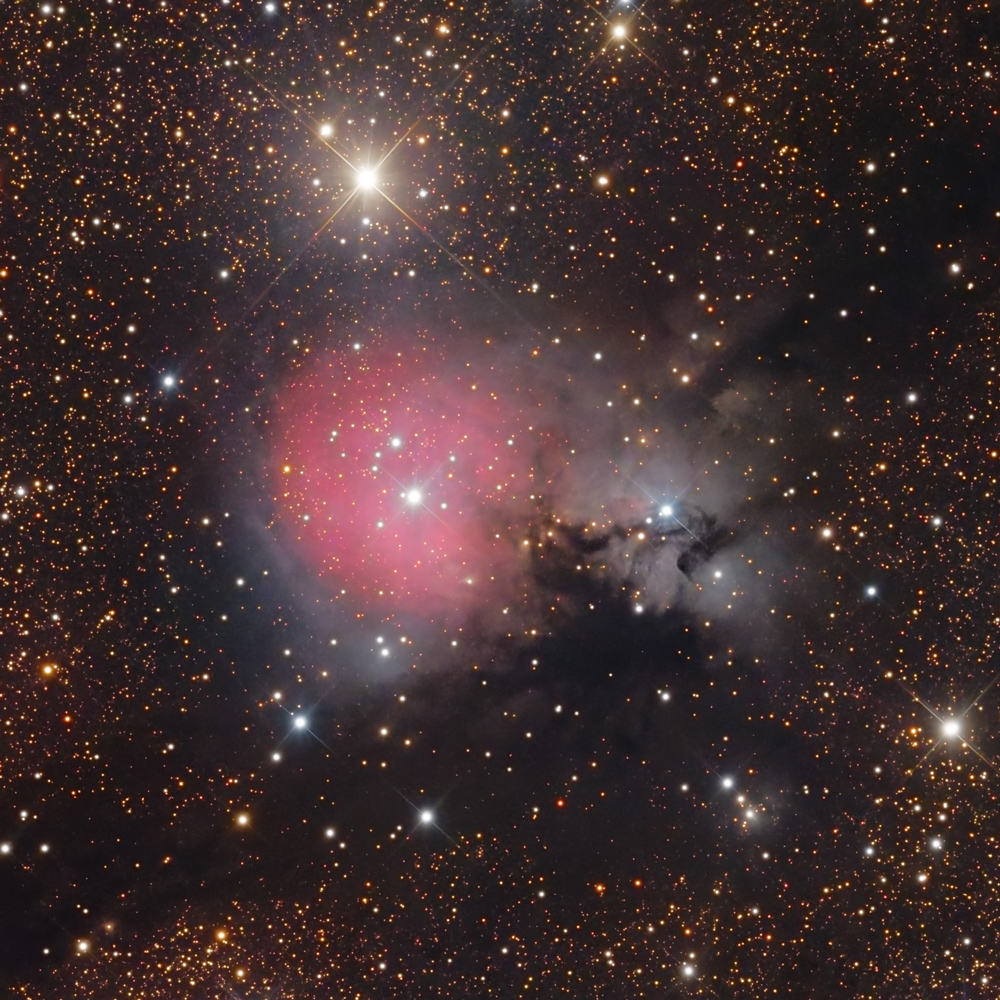
Little Cocoon Nebula
Emission/Reflection Nebula in Sagitta

Click here for uncropped versions: 100% (4096x4096) 65% (2662x2662) 40% (1638x1638)


Sh2-82, sometimes known as the "Little Cocoon Nebula" because of its resemblance to the Cocoon Nebula, is a small emission nebula/reflection nebula visually located in the constellation Sagitta. The red parts of the image are the emissions of ionized hydrogen, resulting from the highly energetic massive new stars recently formed in the region. The blue is caused by the reflection of new, bright blue stars being formed in the region. The dark (obscuring) nebula running diagonally through the image is rather striking, I think, in such proximity to an emission nebula and a reflection nebula.

This beautiful nebula lies in the same plane, viewed from Earth, as the Milky Way, which is why the star field is so dense.

This area is about 3600 light years from us. At that distance, the reflection nebula shown is about 14 light years across at it's longest.


Technical Information:

Ha:L:R:G:B: 600:552:165:135:180 (a total of over 27 hours of light-frame exposure time); here's a chart showing the various subexposures I used in the image (I took more, but ended up tossing a lot of subexposures for a variety of reasons):
Luminance: 31 fifteen-minute and 19 three-minute
Red: 11 fifteen-minute
Green: 9 fifteen-minute
Blue: 9 twenty-minute

Luminance layer is a blend of the two sets of luminance-filtered images and the Ha data.
Red is a blend of the red-filtered images and the Ha data.
Green is entirely the green-filtered images.
Blue is entirely the blue-filtered images.

Equipment: RC Optical Systems 14.5 inch Ritchey-Chrétien carbon fiber truss telescope, with ion-milled optics and RCOS field flattener, at about f/9, and an SBIG STX-16803 with internal filter wheel (SBIG filter set), guided by an SBIG STX Guider, all riding on a Bisque Paramount ME German Equatorial Mount.

Image Acquisition/Camera Control: Maxim DL, controlled with ACP Expert/Scheduler, working in concert with TheSky X.

Processing: All images calibrated (darks, bias and sky flats), aligned, and combined in Pixinsight. Color combine in Pixinsight. Ha data blended into the luminance and color layers in Pixinsight. Some finish work (background neutralization, color calibration, deconvolution (Blur XTerminator), gradient removal, Noise XTerminator for noise reduction, done in Pixinsight; some finish work (LRGB combination, saturation adjustment) was done in Photoshop CC.

Location: Data acquired remotely from Sierra Remote Observatories, Auberry, California, USA.

Date: Images taken on many nights during May and June of 2025. Image posted October 4, 2025.

Date: Image scale of full-resolution image: 0.56 arcseconds per pixel.

Seeing: Generally good

CCD Chip temperature: -25C

Copyright 2025 Mark de Regt

hosting forum
Hit Counter