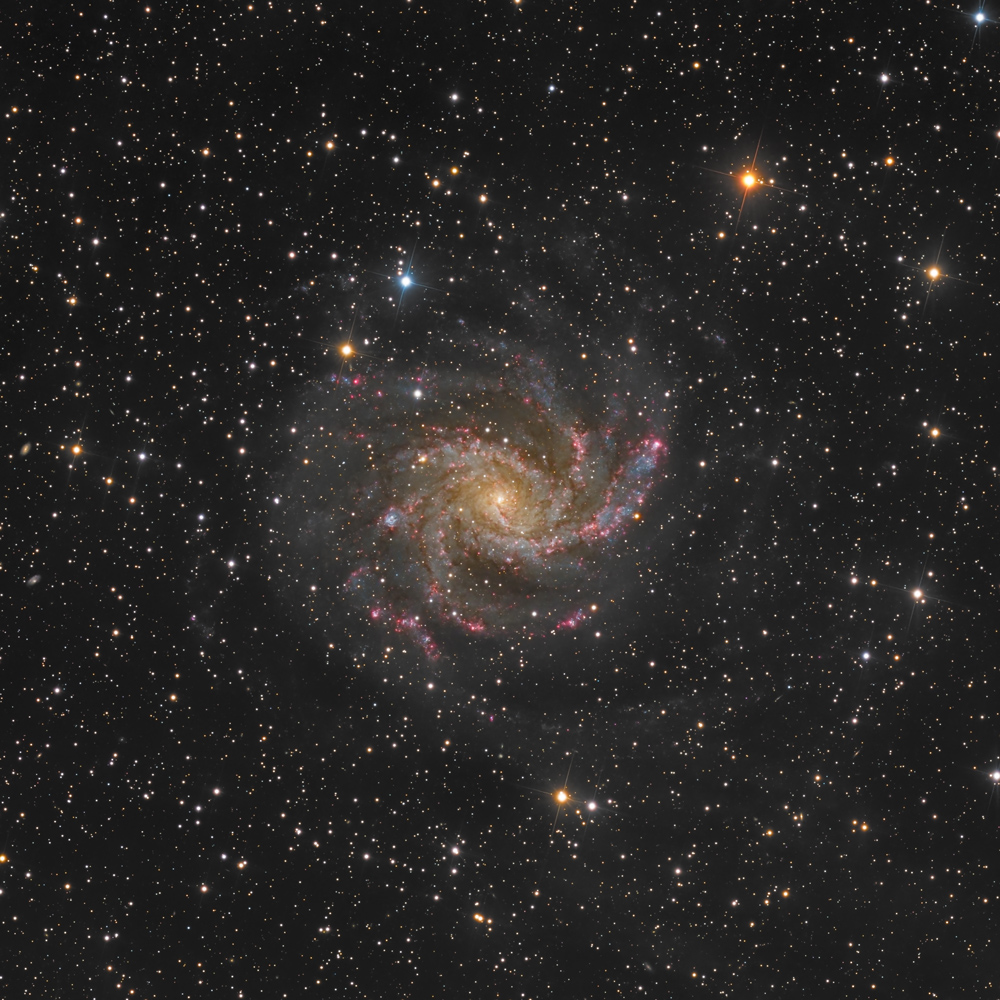
NGC6946 is a large grand design spiral galaxy, fairly close to us (in cosmic terms) at only about 25 million light years distant. It is very dim; a 10th magnitude galaxy in Cepheus toward Cygnus. It is dim in
our skies because its light passes through the plane of our Milky Way galaxy in order to reach us. All the intervening stars (all the individual stars you see in this photo are foreground stars in our own galaxy) and gas/dust attenuates the light a great deal, and because red light survives such a journey better than blue light, the entire galaxy takes on a reddish tone. Were it not obscured by all that dust in our galaxy.
Looking from the bright core outward along the spiral arms, the galaxy's colors show a change from the yellowish light of old stars in the galaxy's center to young blue star clusters and reddish star forming regions. NGC 6946 is also bright in infrared light and rich in gas and dust, exhibiting a high star birth and death rate. During the 20th century, at least six supernovae, the death explosions of massive stars, were discovered in NGC 6946. A small barred structure is just visible at the galaxy's core; it is thought to be a double-barred galaxy.
The pink regions (of which there are many) are star-forming regions; there is so much star formation taking place that this is classified as a "starburst" galaxy. If you look closely at the full-resolution versions, you can see pink
star-forming regions in the far-flung parts of the arms of the galaxy.
The entire field of the uncropped versions of the photo is somewhat more than the width as a full moon. The galaxy has a diameter of about 87,000 light years, and contains perhaps 100 billion stars, about half as many stars as our
Milky Way galaxy contains .
As always, the uncropped versions have a lot of tiny (meaning very far away) galaxies in the background. I particularlay like the barred spiral galaxy on the left edge of the uncropped versions, about half way down.
This interesting galaxy reminds me a lot of IC 342, another grand design spiral galaxy whose light passes through the plane of the Milky Way.
I have photographed this galaxy with every "large" telescope I have used for astrophotography; to see the progression of the picture quality over time:
Meade 10" LX200 with SBIG ST-7E camera, in 2002: here
Meade 12" RCX400 with SBIG ST-8XE camera, in 2006: here
A friend's 16" RCOS with SBIG STL11000M camera, in 2008: here
Copyright 2025 Mark de Regt