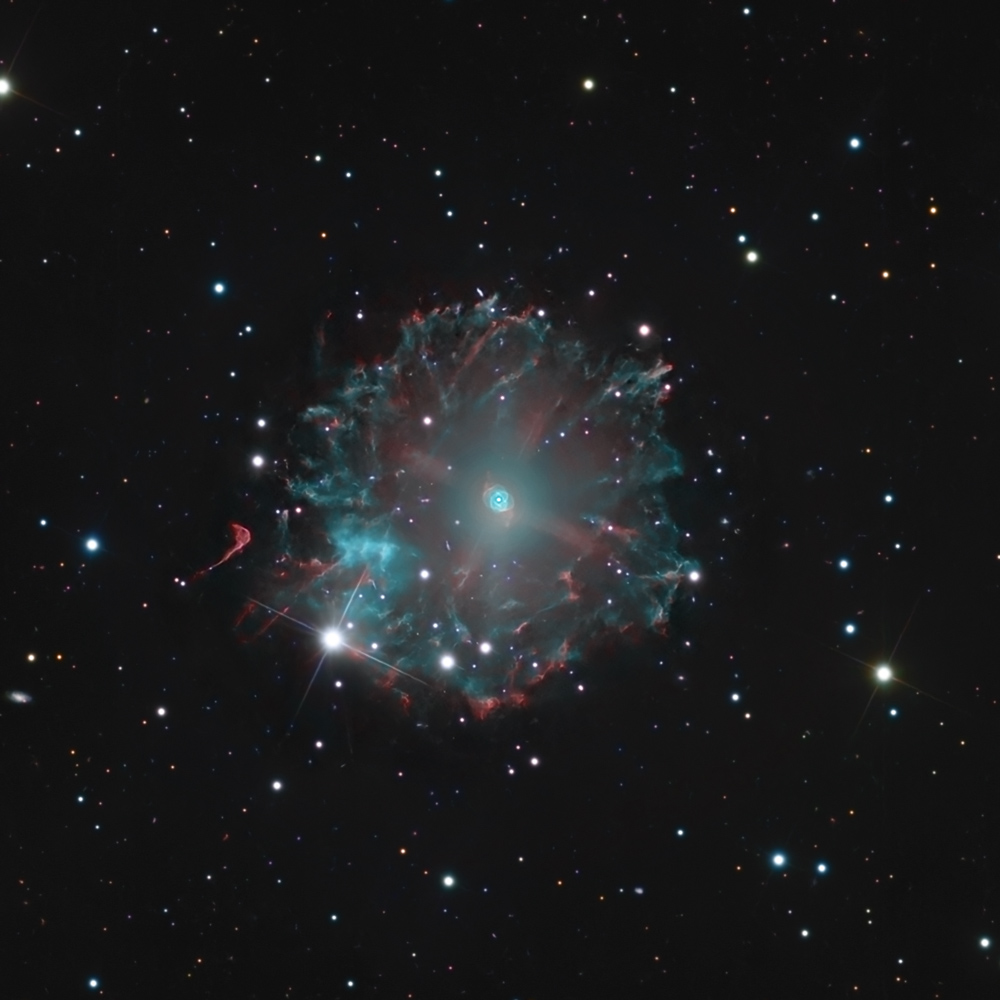
NGC 6543 is a very small (the bright core is only about 20 arcseconds across; that's less that
half the angular size of Jupiter at its closest to earth; the halo is about 8 arcminutes across) planetary nebula in the constellation Draco. Although of modest visual magnitude (8.2), its tiny size
results in an extremely high surface brightness, making it a serious challenge to process; this difficulty is compounded greatly by the extreme dimness of the halo surrounding that bright core, and
the fact that there is a sharp demarcation between the extremely bright and the extremely dim parts. An objective way to see that the core is extremely bright is the presence of four large diffraction
spikes emanating from the core. Technical Information: Ha:OIII:L:R:G:B: 755:1034:411:130:130:322 (a total of over 46 hours of light-frame exposure time spread over 435 images). Here's a chart showing the various subexposures I took: Equipment: RC Optical Systems 14.5 inch Ritchey-Chretien carbon fiber truss telescope, with ion-milled optics and RCOS field flattener, at about f/9, and an SBIG STX-16803 camera with
internal filter wheel (SBIG filter set), guided by an SBIG STX guider, all riding on a Bisque Paramount ME German Equatorial Mount. Image Acquisition/Camera Control: Maxim DL, controlled with ACP Expert/Scheduler, working in concert with TheSky X. Processing: All images calibrated (darks, bias and sky flats), aligned, combined and cropped in Pixinsight. Color combine in Pixinsight. An immense amount of HDR processing was done in
Pixinsight. Some finish work (background neutralization, color calibration, NoiseXTerminator and BlurXTerminator) done in Pixinsight; some cleanup finish work, and (most importantly) blending the various intensities
of the images into an HDR composite) was done in Photoshop CC. Location: Data acquired remotely from Sierra Remote Observatories, Auberry, California, USA. Date: Images taken on many nights in June of 2025. Image posted July 29, 2025. Date: Image scale of full-resolution image: 0.56 arcseconds per pixel. Seeing: Generally good CCD Chip temperature: -25C Copyright 2025
Mark de Regt
A "planetary nebula" (so called because the astronomer who first identified them as nebulae noted the color was similar to the then recently-discovered Neptune) is a structure of gas resulting from the
death throes of a star about the size of our sun, when it runs out of fusable material; the color is the result of the gas being ionized by the remnant of the star, a white dwarf (ionized oxygen is the
dominant emission in this planetary nebulae, giving off the characteristic blue-green color; there also is some ionized hydrogen, which shows a reddish color). It is called the "Cat's Eye Nebula," because
of the resemblance some see between the bright core and a cat's eye.
NGC 6543 is unusual among planetary nebulae in having been formed by a dying Wolf-Rayet star. One effect of this is that, prior to forming
the planetary nebula, the star seems to have been releasing matter in stages, every 1500 years, resulting in a set of concentric bubbles around the core. As it happens, my image shows these bubbles (as rings,
of course, since it's a two-dimensional photo); click here to see an inverted (and enlarged) grayscale image of the nebula; look at the center of the image to see those rings. Click
here to see the spectacular Hubble photo showing these rings, and explaining them.
The bright blue-green blob at about 8 o'clock on the edge of the halo is bright enough to have received its own catalog designation, IC 4677.
It is estimated to be approximately 3,300 light years from earth, which would give it a diameter of about 8 light years (including the halo; the core would be about 0.6 light years across). To put that in perspective,
relative to the size of our solar system, the mean diameter (not radius) of Neptune orbit around our sun is about 0.00096 light years. That's a large nebula--it has a diamter more than 8,000 times that of our solar system
(inside Neptune), and all that gas is ionized by the central star!
As is often the case with large-field deep-sky photographs, there are a lot of tiny (meaning, of course, very far away) galaxies in the background of the uncropped versions of is photo (including and especially
two which show significant structure--NGC 6552, a barred spiral galaxy that seems to have some circular structure (above and to the right of our nebula; about 360 million light years from us), and spiral galaxy PGC 61111
(near the left edge of the image, about half way down; it's about 370 million light years from us)appears to be a distant and large galaxy group midway between the left edge of the galaxy and the left edge of the frame).
I had imaged this region 22 years earlier, in the very early days of my imaging work. I was (and still am) quite pleased with the old image. To see what a bit of acquired skill, much better location and
much better equipment/software can do, compare this current image to my original one here.
Luminance: 41 one-minute; 30 three-minute; 35 eight minute
Red: 30 one-minute; 20 five-minute
Green: 30 one-minute; 20 five-minute
Blue: 30 one-minute; 20 three-minute; 29 eight-minute
Ha: 25 one-minute; 20 five-minute; 21 thirty-minute
OIII: 34 one-minute; 20 five-minute; 30 thirty-minute
Luminance layer is a blend of the luminance-filtered images, the Ha-filtered images and the OIII-filtered images.
Red is a blend of the red-filtered images and the Ha-filtered images.
Green is a blend of the green-filtered images and the OIII-filtered images.
Blue is a blend of the blue-filtered images and the OIII-filtered images.