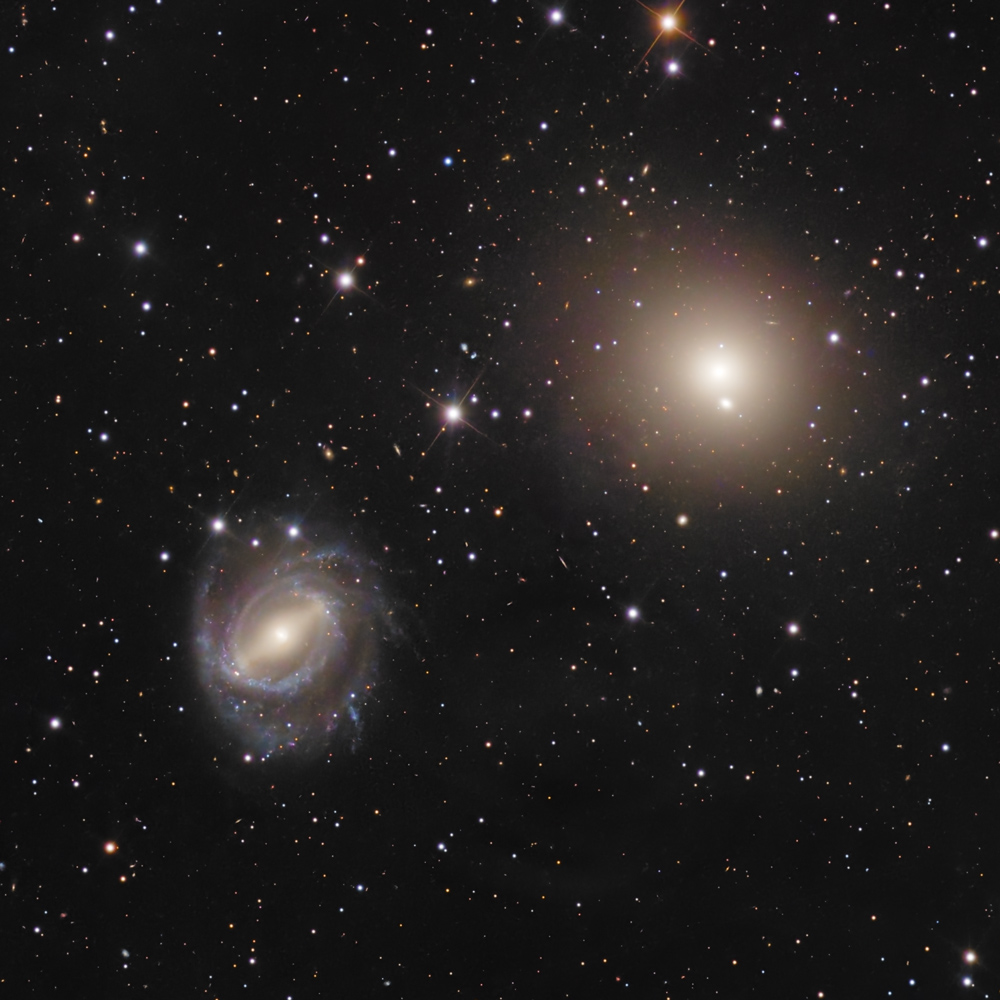
NGC 5850, the galaxy to the left of center in the photo above, is a double-barred spiral
galaxy (meaning that it has two central bars instead of the more common one central bar). The long bar that goes between two o'clock and eight o'clock in the center of the galaxy is
easy to see; the second bar is almost perpendicular to the first, and is quite short, only very near the nucleus. NGC 5846 (above and to the right of NGC 5850) is a large elliptical
galaxy. This field is visually located in the constellation Virgo. Technical Information: L:R:G:B: 557:195:180:180 (a total of over 18 hours of light-frame exposure time); here's a chart showing the various subexposures I used in the image (I
took far more, but ended up tossing a lot of subexposures for a variety of reasons; in addition, I took a full set of Ha-filtered images, but did not use them in the final image): Equipment: RC Optical Systems 14.5 inch Ritchey-Chretien carbon fiber truss telescope, with ion-milled optics and RCOS field flattener, at about f/9, and an SBIG STX-16803 camera with
internal filter wheel (SBIG filter set), guided by an SBIG STX guider, all riding on a Bisque Paramount ME German Equatorial Mount. Image Acquisition/Camera Control: Maxim DL, controlled with ACP Expert/Scheduler, working in concert with TheSky X. Processing: All images calibrated (darks, bias and sky flats), aligned, combined and cropped in Pixinsight. Color combine in Pixinsight. Some finish work (background neutralization,
color calibration, NoiseXTerminator, BlurXTerminator and color combine) done in Pixinsight; some cleanup finish work was done in Photoshop 2025. Location: Data acquired remotely from Sierra Remote Observatories, Auberry, California, USA. Date: Images taken on many nights in April and May of 2025. Image posted September 11, 2025. Date: Image scale of full-resolution image: 0.56 arcseconds per pixel. Seeing: Generally poor to fair CCD Chip temperature: -25C Copyright 2025 Mark de Regt
NGC 5850 presents to us almost face-on, giving us a nice view of the larger bar at its core, and the almost-circular
"ring" formed by its arms. It is very uncertain how far away NGC 5850 is, with scientific estimates varying wildly from 61 million light years away to 131 million light years away from
us; thus, the estimated diameter varies from 89,000 light years to 191,000 light years (our Milky Way galaxy, a very large galaxy, is thought to be about 120,000 light years across).
The entire field of the uncropped versions is about the angular size of a full moon.
NGC 5846 is thought to be aout 90 million light years from us, and about 110,000 light years across. As is common with elliptical galaxies, NGC 5846 has a large population of globular
clusters orbiting its core.
This image is a cropped piece of the entire field I photographed; if you click through where indicated, there are three different resolution versions of the entire (uncropped) version.
As is often the case with large-field deep-sky photographs, there are a lot of tiny (meaning, of course, very far away) galaxies in the background of this photo (including and especially a
number that show significant structure).
Luminance: 25 twenty-minute and 19 three-minute
Red: 13 fifteen-minute
Green: 12 fifteen-minute
Blue: 9 twenty-minute
Luminance layer is a blend of the two sets of luminance-filtered images.
Red is entirely the red-filtered images.
Green is entirely the green-filtered images.
Blue is entirely the blue-filtered images.