HOME
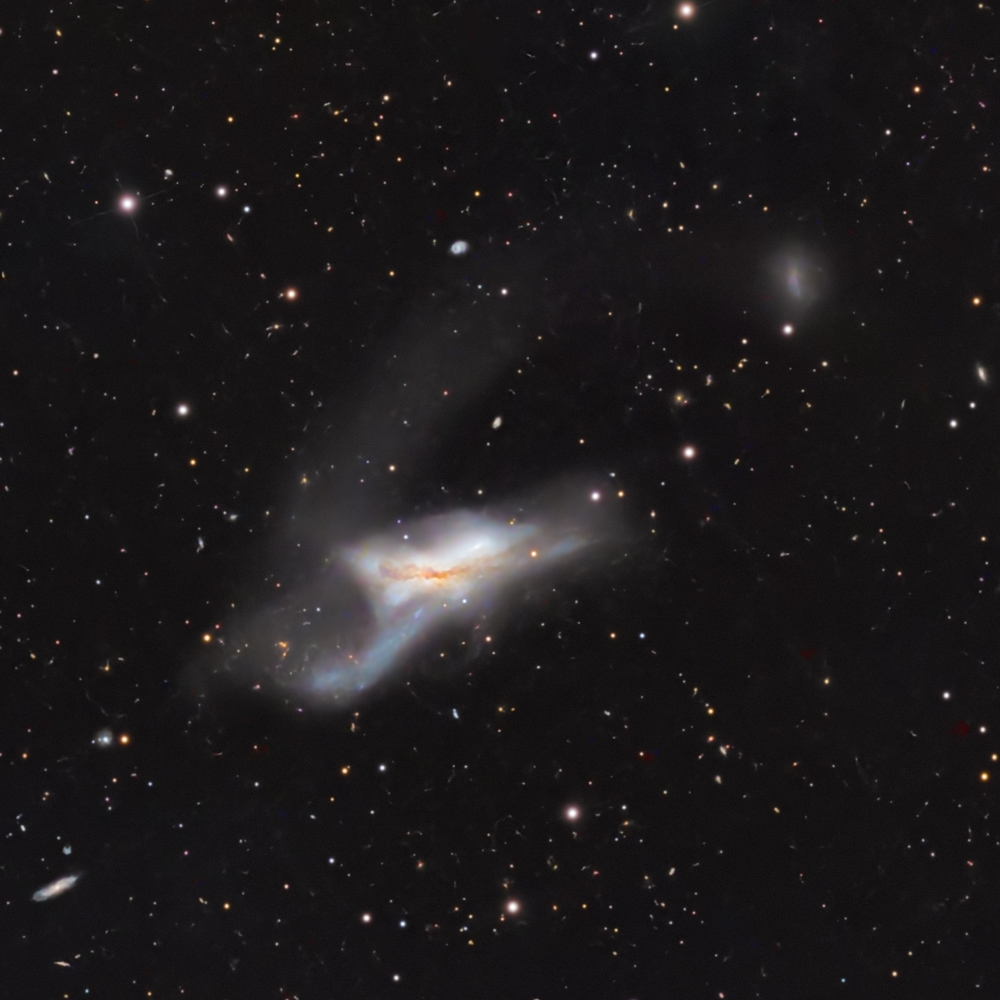
NGC 520
NGC 520
Arp 157
Colliding Spiral Galaxies in Pisces

Click here for other versions: 50% uncropped (2048x2048)   100% uncropped (4096x4096)


NG 520 is a pair of spiral galaxies, in the extended process of colliding/merging, as evidenced by the tidal tail of stars and dust between the larger galaxy and the smaller one (the large smudge above and to the right of the larger one); apparently, the smaller one smashed through the edge of the larger one long ago, and its nucleus has moved beyond. But gravity will pull them together again (indeed, the smaller nucleus seems to be circling back), in an intricate dance that will take a very long time to complete. This system is estimated to have started the process of a merger about 300 million years ago, and it still is in the early stages. It is located about 105 million light years from us; the larger galaxy is about 100,000 light years in diameter (similar in size to our Milky Way, a large galaxy).

The larger galaxy is presenting to us a approximately edge-on, as shown by the reddish-brown dust lane in the middle.

The strong blue glow in the lower left of the image is from a very bright, blue star just outside the field of this image.

I always enjoy looking at the small background galaxies in many of my images; there are many throughout the uncropped image.

The entire field of the uncropped version of the photo is about the same width as a full moon.


Technical Information:

LRGB: 690:180:225:240 (a total of over 27 hours of light-frame exposure time); here's a chart showing the various subexposures I used in the image:

Luminance: 31 thirty-minute (10 of which were discarded during processing), and 20 three-minute
Red: 12 fifteen-minute
Green: 15 fifteen-minute
Blue: 12 twenty-minute


Equipment: RC Optical Systems 14.5 inch Ritchey-Chrétien carbon fiber truss telescope, with ion-milled optics and RCOS field flattener, at about f/9, and an SBIG STX-16803 with internal filter wheel (SBIG filter set), guided by an SBIG STX Guider, all riding on a Bisque Paramount ME German Equatorial Mount.

Image Acquisition/Camera Control: Maxim DL, controlled with ACP Expert/Scheduler, working in concert with TheSky X.

Processing: All images calibrated (darks, bias and sky flats), aligned, and combined in Pixinsight. Color combine in Pixinsight. Some finish work (background neutralization, color calibration, Noise XTerminater, Blur XTerminator) done in Pixinsight; some finish work (LRGB combination, contrast and saturation adjustment) was done in Photoshop CC.

Location: Data acquired remotely from Sierra Remote Observatories, Auberry, California, USA.

Date: Images taken on many nights during October, November and December of 2025. Image posted March 14, 2026.

Date: Image scale of full-resolution image: 0.56 arcseconds per pixel.

Seeing: Variable, but generally ok.

CCD Chip temperature: -25C

Copyright 2025, 2026 Mark de Regt

hosting forum
Hit Counter