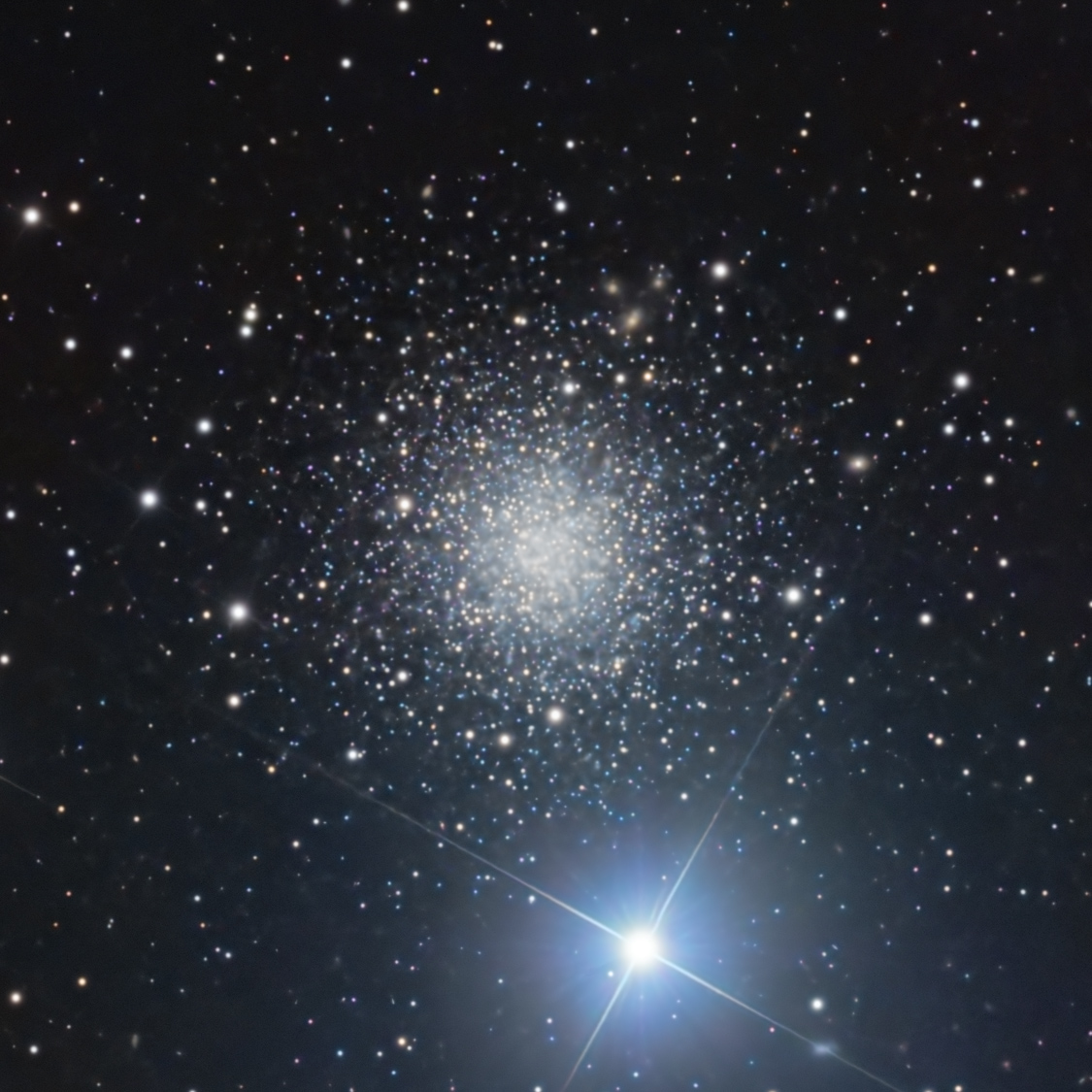
NGC 2419 is a very large, and very distant, globular cluster orbiting our Milky Way galaxy. A globular cluster is a group of ancient stars gravitationally bound into a spherical
shape, orbiting the core of its associated galaxy. NGC 2419 is thought to be 12.3 billion years old. By comparison, our sun is about 4.6 billion years old; our galaxy is about 13.5 billion years old, and the universe is thought to be 13.77 billion years old.
NGC 2419 is about 275,000 light years from Earth (about 300,000 light years from the center of our galaxy); to put that into perspective, all the other globular clusters I have imaged are between 13,000
light years away and 55,000 light years away. The Milky Way is "only" a bit over 100,000 light years across, so this cluster is a
LONG way away, and takes about 3 billion years to complete one revolution around the galaxy. It is roughly 300 light years across, making it a very large cluster. It shines at
magnitude 10.3 (faint in a small telescope, in very dark skies). It has a mass equal to about 900,000 times that of our sun.
This is so far away that it was long theorized that it was not attached to our galaxy at all, but was an "intergalactic wanderer."
The very bright star in the cropped image is a magnitude 7 star (that's very bright, almost visible to the naked eye in dark skies) much closer to us (as the other bright stars in the uncropped version
are much closer to us than is NGC 2419). It is rather remarkable to me that we fortunate amateur astronomers of this age have access to (relatively) affordable telescopes and cameras that allow us
to capture individual stars that are 275,000 light years away.
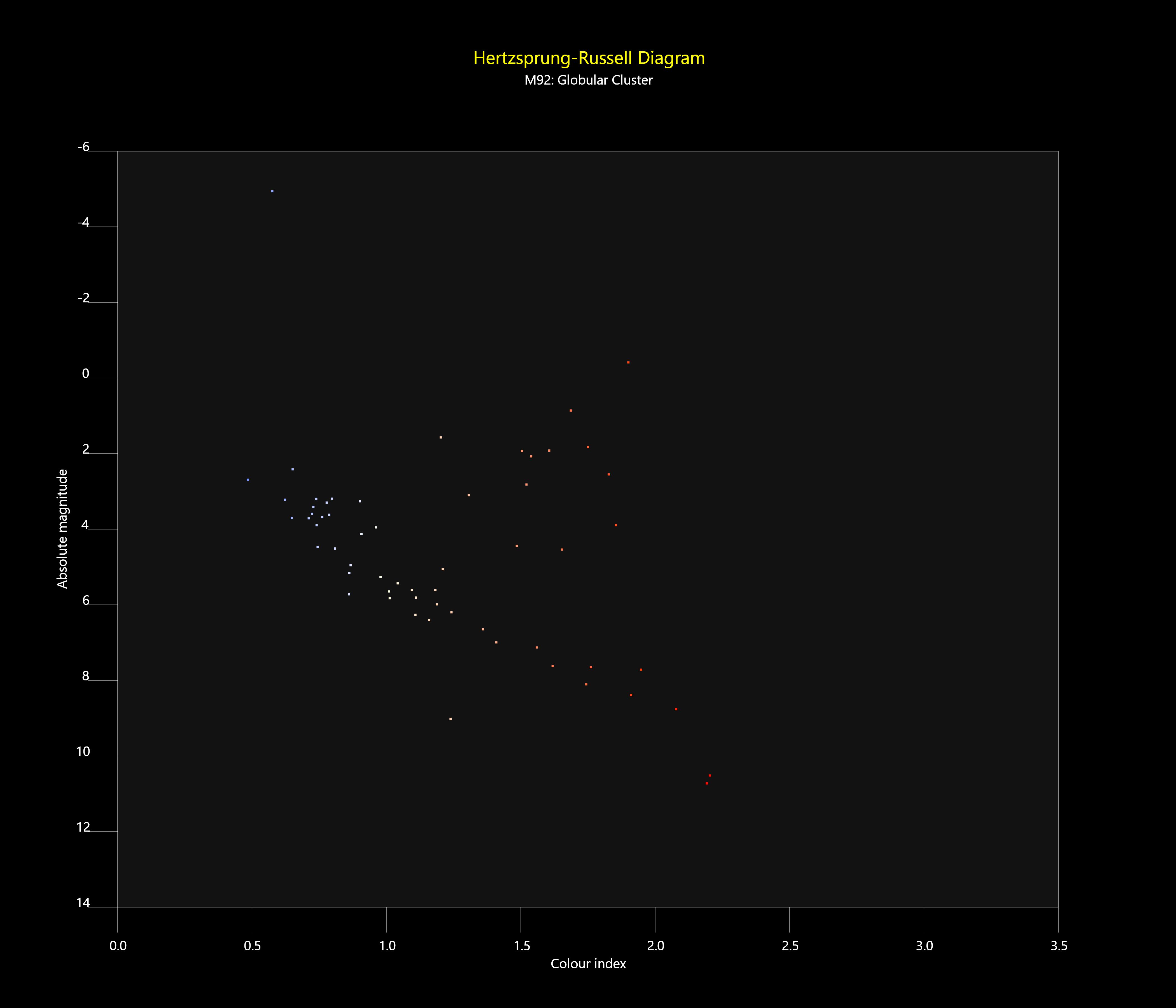
Because all the stars in a globular cluster are essentially the same distance from us (relative to the absolute distance from us), it is interesting to create a Hertzsprung-Russell diagram ("HR Diagram") of
the members of the cluster. To learn about HR Diagrams, click here. I have done just that for this ancient cluster; ths
chart is here. In addition to the interesting science, I think that this is a useful way to validate (or not) the colors the software created for the cluster from my data. Note that this diagram shows very few stars, compared to the HR Diagram of the other globular clusters which I have imaged; I believe that this is
because this one is so very far away that few stars in the cluser are bright enough to have been imaged.
Copyright 2025, 2026 Mark de Regt