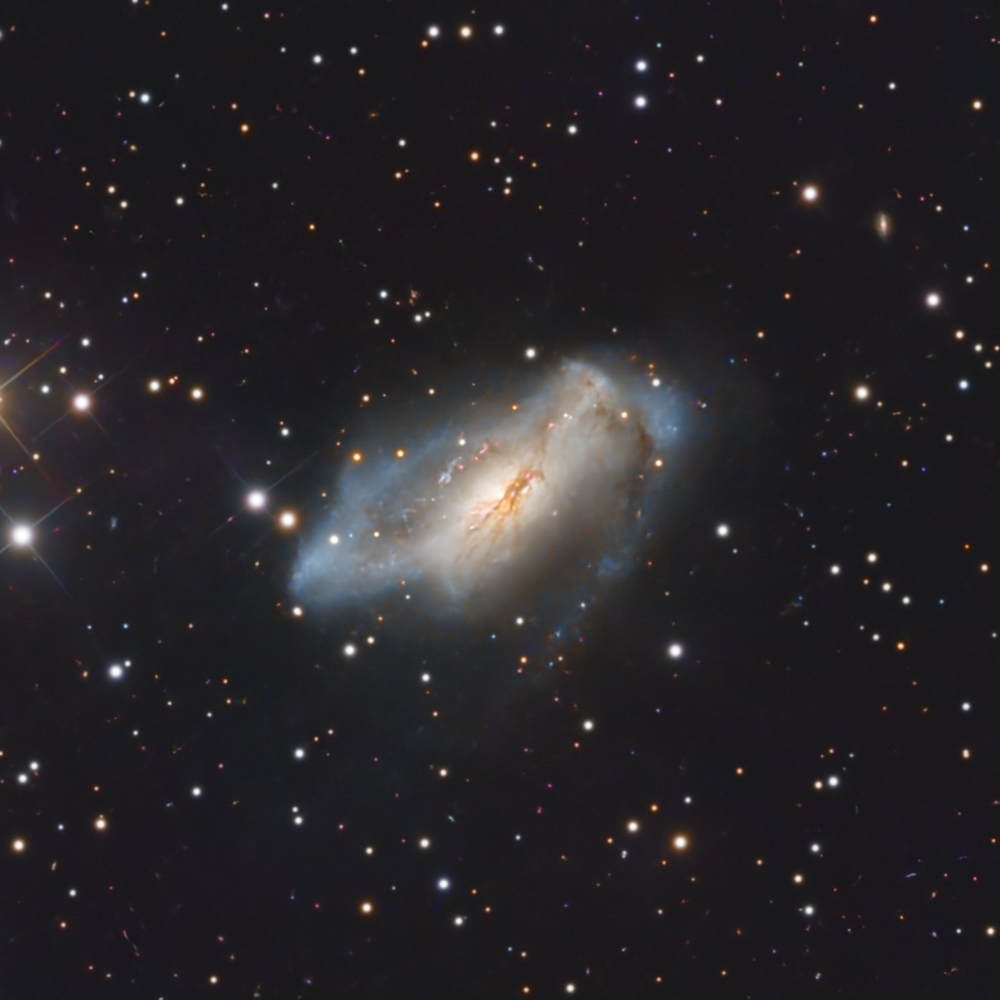
NGC 2146 is a large barred spiral
galaxy, severely misshapen by a long ago collision with another galaxy (estimated to have taken place 800 million years ago). The dusty-looking stuff surrounding the galaxy, and
heading out from the galaxy, is a tidal tail, a tell-tale for a collision (or close encounter) between galaxies. It is thought
that the result of that long-ago collision may have been that NGC 2146 absorbed the smaller galaxy (resistance is futile). As is often the case with large-field deep-sky photographs,
there are a lot of smaller (generally meaning, of course, very far away) galaxies in the background of this photo, including and especially the smaller intermediate spiral galaxy in
the upper-left corner of the uncropped versions (NGC 2146A), thought to be a companion galaxy of NGC 2146 (being about the same distance from us); it is not know if NGC 2146A played
any part in the collisionthat deformed NGC 2146. As a result of that collision, NGC 2146 is experience a high level of star-formation, and is classified as a
"starburst galaxy." Technical Information: Ha:L:R:G:B: 600:915:180:180:260 (a total of almost 36 hours of light-frame exposure time); luminance was a blend of 15-minute images and 3-minute images; red
were all 15-minute images, with the Ha data blended into it; green exposures were all 15-minute exposures; blue all 20-minute exposures. The luminance layer consisted of 57
fifteen-minute images through the luminance filter and 20 three-minute images. The red channel is a combination of twelve 15-minute images thorugh a red filter 30 twenty-minute
images through an Ha filter. The green channel is a combination of twelve 15-minute images through the green filter. The blue channel is a combination of twelve 20-minute images
through a blue filter. Equipment: RC Optical Systems 14.5 inch Ritchey-Chretien carbon fiber truss telescope, with ion-milled optics and RCOS field flattener, at about f/9, and an
SBIG STX-16803 camera with internal filter wheel (SBIG filter set), sometimes guided by an SBIG AO-X, all riding on a Bisque Paramount ME German Equatorial Mount. Image Acquisition/Camera Control: Maxim DL, controlled with ACP Expert/Scheduler, working in concert with TheSky X. Processing: All images calibrated (darks, bias and sky flats), aligned, combined and cropped in Pixinsight. Color combine in Pixinsight. Some finish work
(cropping of the masters; gradient correction; HDR combination of the luminance data; NoiseXTerminator; BlurXTerminator; background neutralization, color calibration and color combine)
done in Pixinsight; some cleanup finish work was done in Photoshop CC. Location: Data acquired remotely from Sierra Remote Observatories, Auberry, California, USA. Date: Images taken on many nights in December 2024 and January 2025. Image posted July 10, 2025. Date: Image scale of full-resolution image: 0.56 arcseconds per pixel. Seeing: Variable, but generally very poor. CCD Chip temperature: -25C Copyright 2024, 2025
Mark de Regt
Perhaps related to the high level of star formation, NGC 2146 has hosted a number of supernovae. By coincidence, one of these spectacular explosions (SN 2024abfl) occurred just weeks
before I took these photos, and it is captured in this photo. To give an idea of the power of such explosions, all the individual stars in this photo, except one, are in our
galaxy, and quite near to us; the vast majority are within a few thousand light years from us. This galaxy is 70 million light years away, and the supernova looks like a moderately bright
star in this image, even though it is over ten thousand time farther away than any of the other stars. Click on the image to see the supernova pointed out in the image.
The galaxy is about 80,000 light years across, a bit smaller than our Milky Way.