HOME
Messier 99
M99
NGC 4254
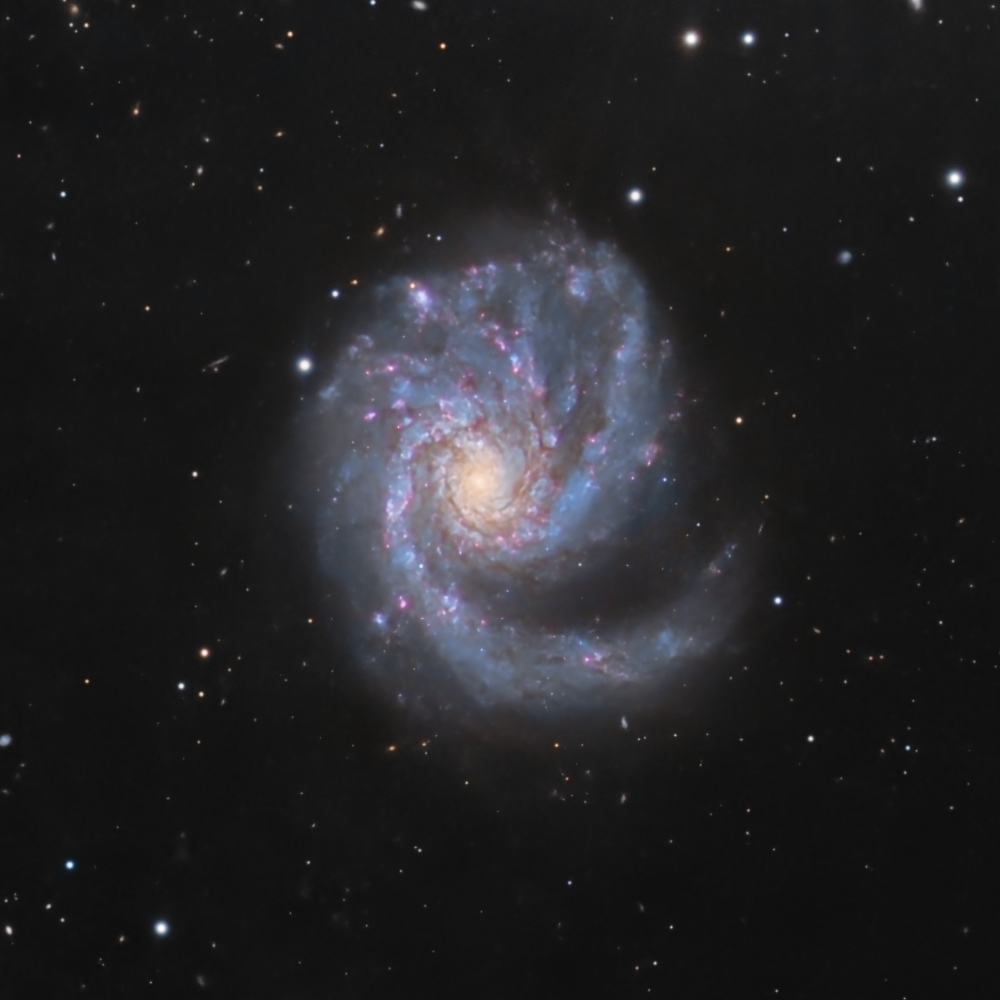
Grand Design Spiral Galaxy in Coma Berenices

Click here for uncropped versions: 100% (4096x4096)  65% (2662x2662)   40% (1638x1638)


M99 is a large, fairly bright, grand design spiral galaxy, somewhat misshapen by a gravitational interaction (see below for a discussion of that interaction), leaving one spiral arm more loosely wrapped around the center of the galaxy.

Perhaps related to the apparent collision with another galaxy is the high level of star formation in M99. While not classified as a "starburst" galaxy, its rate of star formation is three times the "normal" rate; the pinkish regions in the galaxy arms are areas of particularl energetic star formation, and, even at this distance, a lot of them are evident in this photo.

This pretty galaxy present to us angled 42 degrees from edge-on, so is looks a bit elliptical.

This galaxy is about 55 million light years away; at that distance, the galaxy is about 86,000 light years in diameter, a moderately large galaxy (though significantly smaller than our Milky Way galaxy). It has only a tiny fraction as many stars as the Milky Way has. But it is quite small in our sky, having an angular diameter of about 5.5 arcminutes (less than one-fifth the angular diamger of our moon in our sky). Looking at the uncropped versions, it is interesting, to me, to contemplate that there are bilions of galaxies, each of which is huge and has billions of stars, and, yet, it's an empty universe, as this photo shows (empty in terms of the vast distances between galaxies). But it is equally interesting to look at a photo like this one and note the dozens and dozens of tiny (meaning very far away) galaxies (note especially all the galaxies clustered around the very bright star in the upper right of the photo, all of which are hundreds of millions of light years away from us.

There is a bridge of non-ionized hydrogen, not detectable without very fancy instruments, linking M99 with VIRGOHI21, a huge region with immense amounts of non-ionized hydrogen, which is thought possibly to be a dark galaxy.


Technical Information:

Ha:L:R:G:B: 380:450:195:180:240 (a total of over 24 hours of light-frame exposure time); here's a chart showing the various subexposures I used in the image (I took far more, but ended up tossing a lot of subexposures for a variety of reasons):
Luminance: 30 fifteen-minute and 20 three-minute
Red: 13 fifteen-minute
Green: 12 fifteen-minute
Blue: 12 twenty-minute
Ha: 19 twenty-minute

Luminance layer is a blend of the two sets of luminance-filtered images.
Red is a blend of the red-filtered images and the Ha-filtered images.
Green is entirely the green-filtered images.
Blue is entirely the blue-filtered images.

Equipment: RC Optical Systems 14.5 inch Ritchey-Chretien carbon fiber truss telescope, with ion-milled optics and RCOS field flattener, at about f/9, and an SBIG STX-16803 camera with internal filter wheel (SBIG filter set), all riding on a Bisque Paramount ME German Equatorial Mount.

Image Acquisition/Camera Control: Maxim DL, controlled with ACP Expert/Scheduler, working in concert with TheSky X.

Processing: All images calibrated (darks, bias and sky flats), aligned, combined and cropped in Pixinsight. Color combine in Pixinsight. Some finish work (cropping of the masters; gradient correction; HDR combination of the luminance data; NoiseXTerminator; BlurXTerminator; background neutralization, color calibration and color combine) done in Pixinsight; some cleanup finish work was done in Photoshop CC.

Location: Data acquired remotely from Sierra Remote Observatories, Auberry, California, USA.

Date: Images taken on many nights in April and May of 2025. Image posted August 20, 2025.

Date: Image scale of full-resolution image: 0.56 arcseconds per pixel.

Seeing: Variable; sometimes quite good, but often poor.

CCD Chip temperature: -25C

Copyright 2025 Mark de Regt

hosting forum
Hit Counter