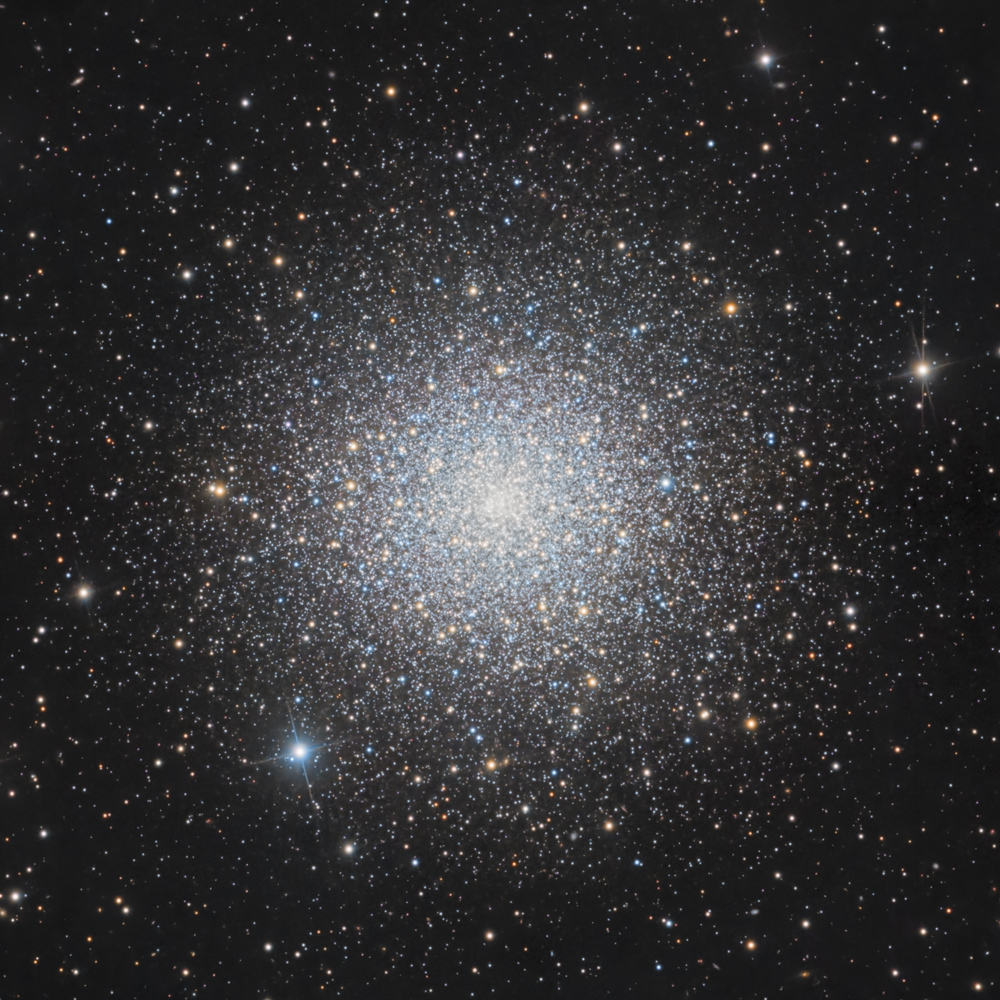
M92: A globular cluster is a group of ancient stars (M92 is thought to be 13.8 billion years old, gravitationally bound into a spherical shape; by comparison, our sun is about
4.6 billion years old; our galaxy is about 13.5 billion years old, and the universe is thought to be only slightly older than M92), orbiting the core of its associated galaxy.
M92 is about 26,700 light years from Earth, and is about one-half of the angular size of the full moon when viewed from very dark skies. It is roughly 108 light years across. It shines at
magnitude 6.4 (barely visible, in very dark skies, to the naked eye, but easily seen with binoculars). It has a mass equal to about 330,000 times that of our sun (for comparison, there are
estimated to be no more than 2,000 stars within 50 light years of earth, which is a similar-sized bubble); it would be a very bright "night sky" on a planet in the midst of that cluster!
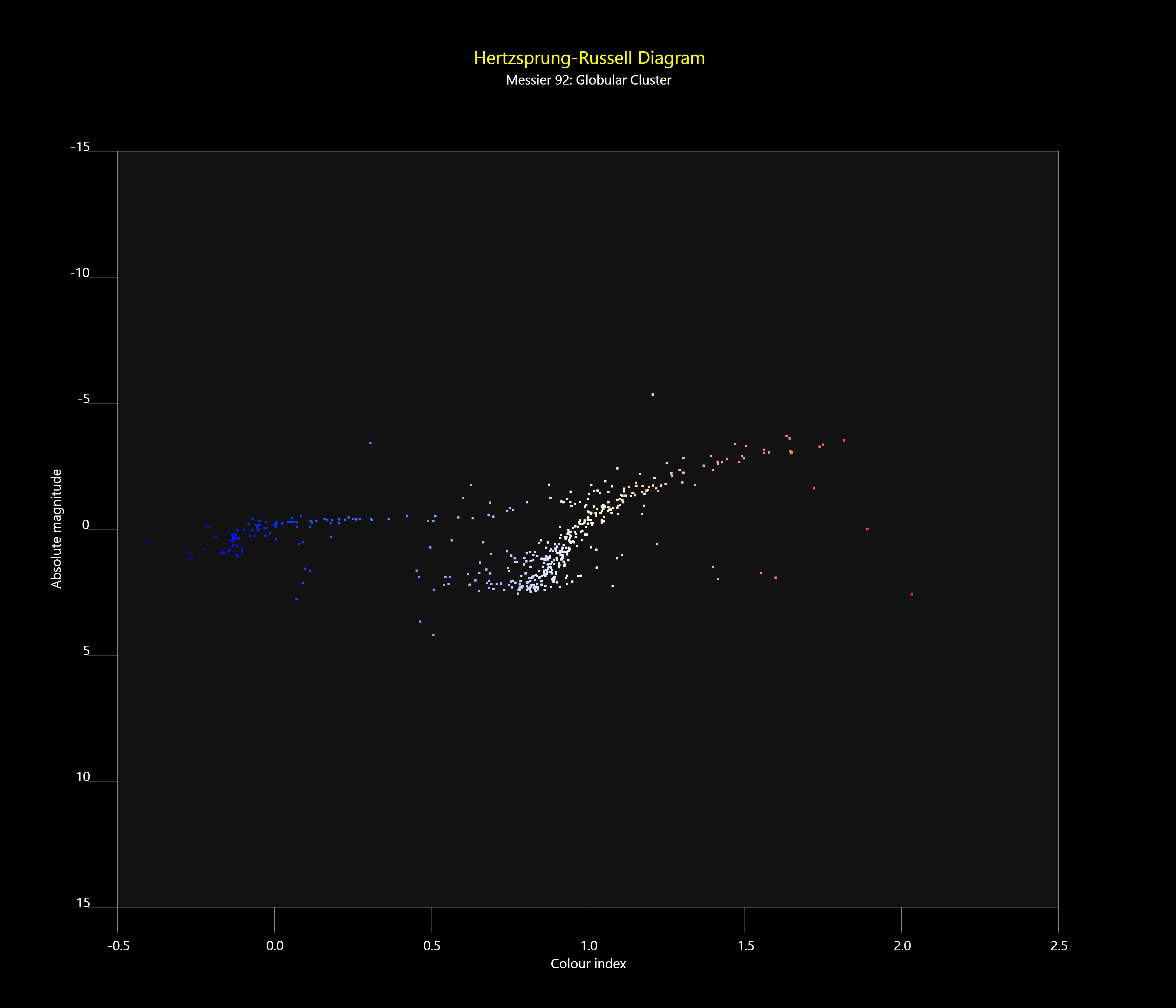
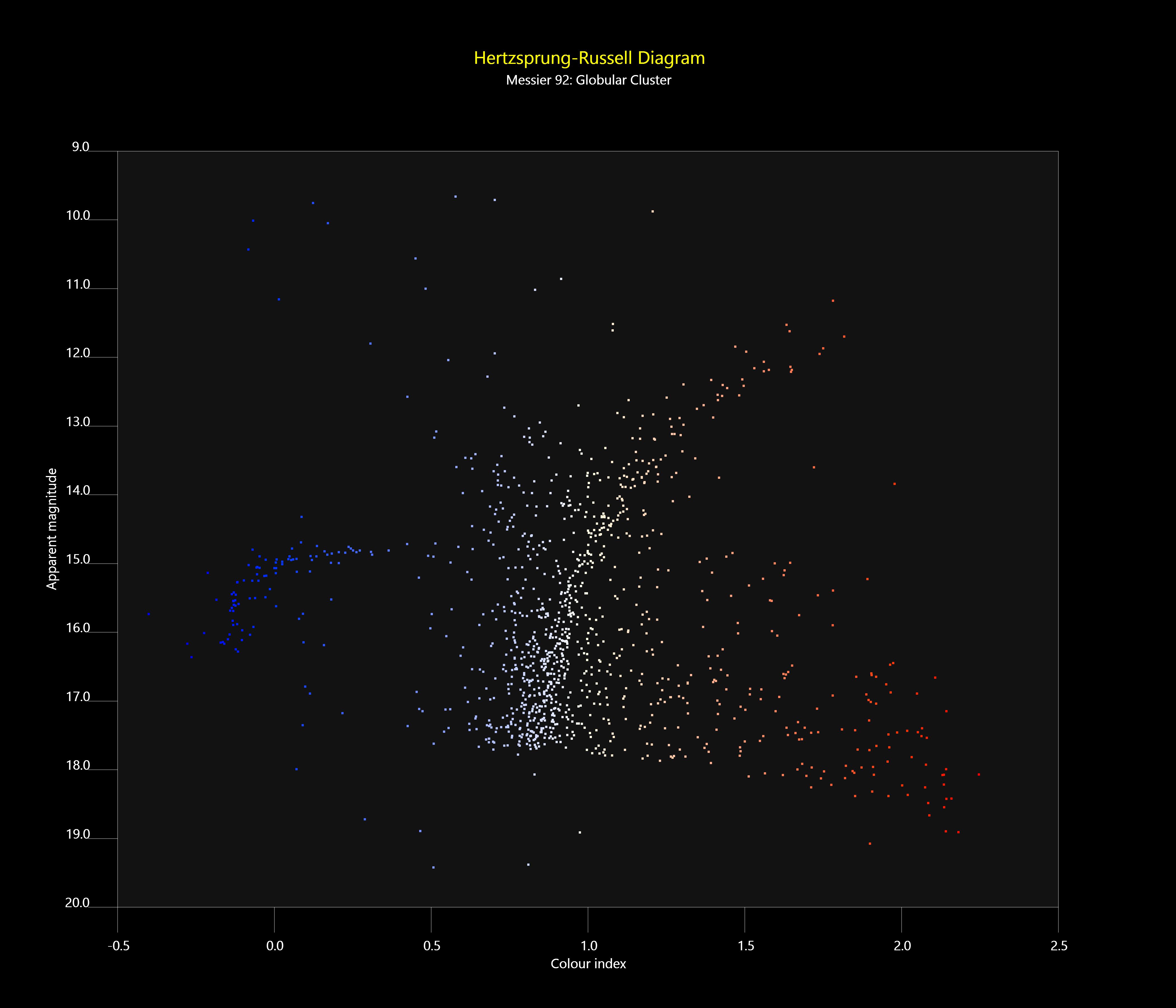
Because all the stars in a globular cluster are essentially the same distance from us (relative to the absolute distance from us), it is interesting to create a Hertzsprung-Russell diagram ("HR Diagram") of
the members of the cluster. To learn about HR Diagrams, click here. I have done just that for this ancient cluster; those
charts are here (absolute magnitude) and here
(apparent magnitude). In addition to the interesting science, this is an interesting way to validate the colors the software created for the cluster from my data.
I last imaged this cluster 20 years earlier. To see what a combination of better equipment, better skies, better software, and better skills does, click here
Copyright 2025 Mark de Regt