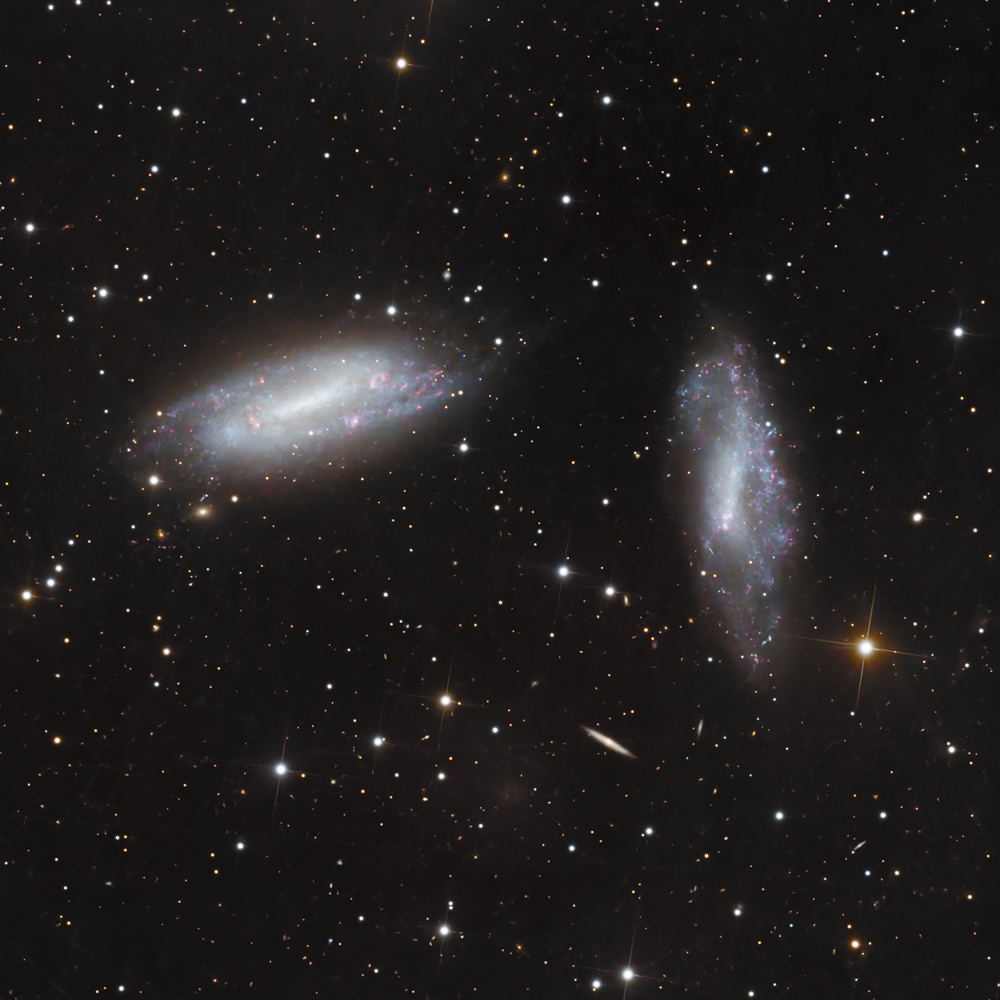
NGC 672and IC 1727 are a pair of galaxies (NGC 672 is a barred spiral galaxy; IC 1727 is an irregular galaxy), gravitationally interacting. NGC 672 is
the one on the left (more or less horizontal in the photo). Scientists have discovered that there was greatly increased star formation in both galaxies 20-30 million years
ago, and 450-750 million years ago, from which they conclude that (i) the two have had very close encounters in the past, and (ii) they likely will merge into one galaxy
sometime in the future. The pinkish spots dotting both galaxies are star-forming regions.
Both are about 23 million light years from us; at that distance, NGC 672 is about 48,000 light years across, while IC 1727 is about 50,000 light years across (both are modest
in size, compared to our Milky Way galaxy, which has more than twice the diameter of both of them. The distance between the galaxies is about 88,000 light years.
As usual, there are MANY background galaxies in this photo (galaxies in the same line of sight, but much farther away that the principal target(s)). In particular, the one
to the left of the bottom of IC 1727 is PGC 1803573, a spiral galaxy about 500 million light years away from us. When those photons my camera captured started their journey,
Earth had only microbial life on land, and the continents were bunched up together.
There is a faint smudge below and to the left of PGC 1803573, which apparently is real, since it shows up in some other amateur photos. But I have not been able to identify it.
The entire field of the uncropped version of the photo is about the same width as a full moon.
Technical Information:
HaLRGB: 660:980:270:270:300 (a total of over 41 hours of light-frame exposure time); here's a chart showing the various subexposures I used in the image:
Hydrogen Alpha: 33 twenty-minute images
Luminance: 46 twenty-minute and 20 three-minute
Red: 18 fifteen-minute
Green: 18 fifteen-minute
Blue: 15 twenty-minute
The luminance layer is a HDR blend of the 20-minute images and the three-minute images.
The red channel is a blend of the red data and the Ha data.
The green channel is made up entirely of the green data.
The blue channel is made up entirely of the blue data.
Equipment: RC Optical Systems 14.5 inch Ritchey-Chrétien carbon fiber truss telescope, with ion-milled optics and RCOS field flattener, at about f/9, and an
SBIG STX-16803 with internal filter wheel (SBIG filter set), guided by an SBIG STX Guider, all riding on a Bisque Paramount ME German Equatorial Mount.
Image Acquisition/Camera Control: Maxim DL, controlled with ACP Expert/Scheduler, working in concert with TheSky X.
Processing: All images calibrated (darks, bias and sky flats), aligned, and combined in Pixinsight. Color combine in Pixinsight. Some finish work (background neutralization, color
calibration, Noise XTerminater, Blur XTerminator) done in Pixinsight; some finish work (LRGB combination, contrast and saturation adjustment) was done in Photoshop CC.
Location: Data acquired remotely from Sierra Remote Observatories, Auberry, California, USA.
Date: Images taken on many nights during January, February and March of 2026. Image posted July 9, 2026.
Date: Image scale of full-resolution image: 0.56 arcseconds per pixel.
Seeing: Variable, but generally mediocre.
CCD Chip temperature: -25C
Copyright 2026 Mark de Regt