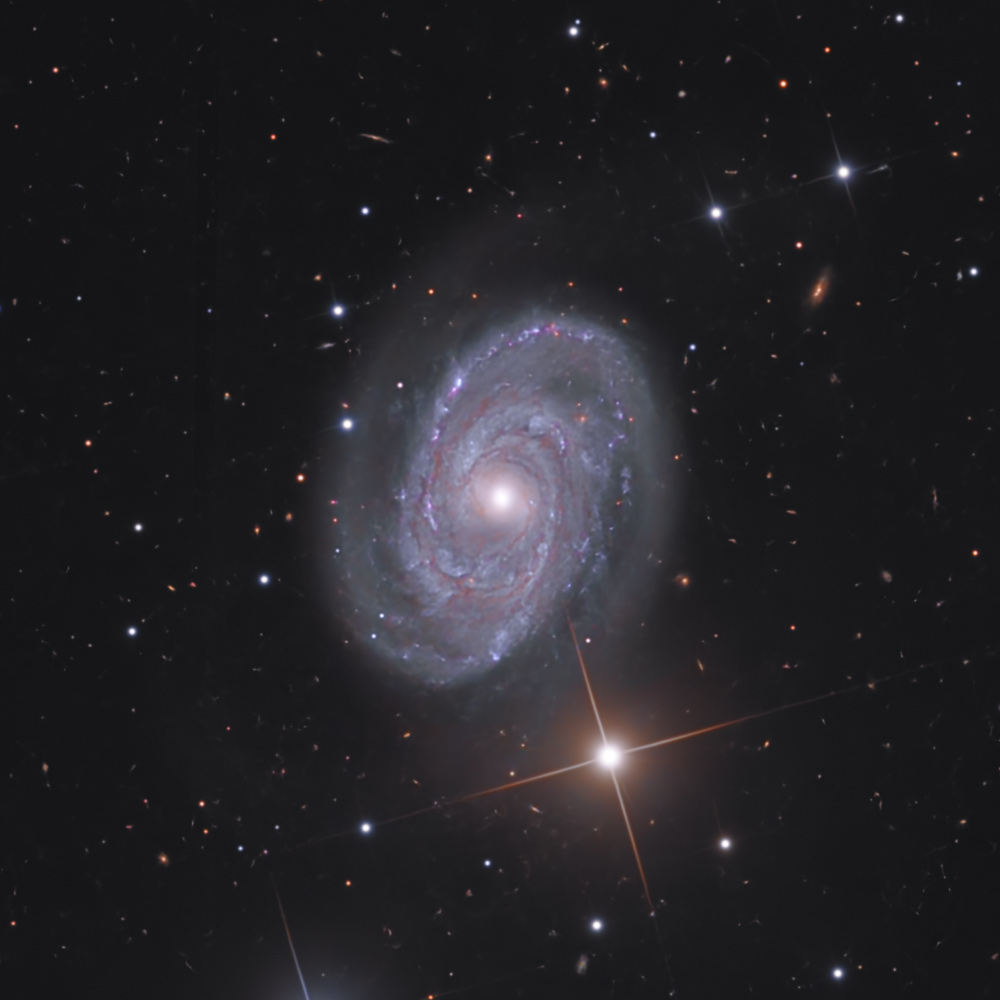
NGC 5371 and NGC 5390 are two names for the same distant spiral galaxy, visually located in the constellation
Canes Venatici. It presents to us angled about 45 degrees from face-on, giving it an elliptical appearance. It is thought to be about 130 million light years away from us, which would give it a
diameter of approximately 146,000 light years, making it a large galaxy (our Milky Way now is thought to be a bit smaller). The entire field of the uncropped versions is about the angular
size of a full moon. Technical Information: Ha:L:R:G:B: 480:1000:180:255:260 (a total of over 36 hours of light-frame exposure time). Here's a chart showing the various subexposures I took: Equipment: RC Optical Systems 14.5 inch Ritchey-Chretien carbon fiber truss telescope, with ion-milled optics and RCOS field flattener, at about f/9, and an SBIG STX-16803 camera with
internal filter wheel (SBIG filter set), guided by an SBIG STX guider, all riding on a Bisque Paramount ME German Equatorial Mount. Image Acquisition/Camera Control: Maxim DL, controlled with ACP Expert/Scheduler, working in concert with TheSky X. Processing: All images calibrated (darks, bias and sky flats), aligned, combined and cropped in Pixinsight. Color combine in Pixinsight. Some finish work (background neutralization,
color calibration, NB blend, Noise XTerminator and Blur XTerminator) done in Pixinsight; some cleanup finish work was done in Photoshop 2026. Location: Data acquired remotely from Sierra Remote Observatories, Auberry, California, USA. Date: Images taken on many nights in April, May and June of 2026. Image posted November 13, 2026. Date: Image scale of full-resolution image: 0.56 arcseconds per pixel. Seeing: Generally good. CCD Chip temperature: -25C Copyright 2026 Mark de Regt
This image is a heavily-cropped piece of the entire field I photographed; if you click through where indicated, there are three different resolution versions of the entire (uncropped) version. As is often
the case with large-field deep-sky photographs, there are a lot of tiny (meaning, of course, very far away) galaxies in the background of this photo (including and especially a number that show significant
structure (PGC 49480 at the top center of the uncropped versions; the ghostly blob above and to the right of NGC 5390 is PGC 166184; a bit of the galaxy group Hickson Compact Group 68 is just showing in
the upper left corner of this image, including NGC 5355.
Luminance: 20 one-minute; 47 twenty-minute
Red: 12 fifteen-minute
Green: 17 fifteen-minute
Blue: 13 twenty-minute
Ha: 24 twenty-minute
Luminance layer is a blend of the one-minute and twenty-minute luminance-filtered.
Red is a blend of the red-filtered images and the Ha-filtered images.
Green is made up entirely of the green-filtered images.
Blue is made up entirely of the blue-filtered images.