HOME
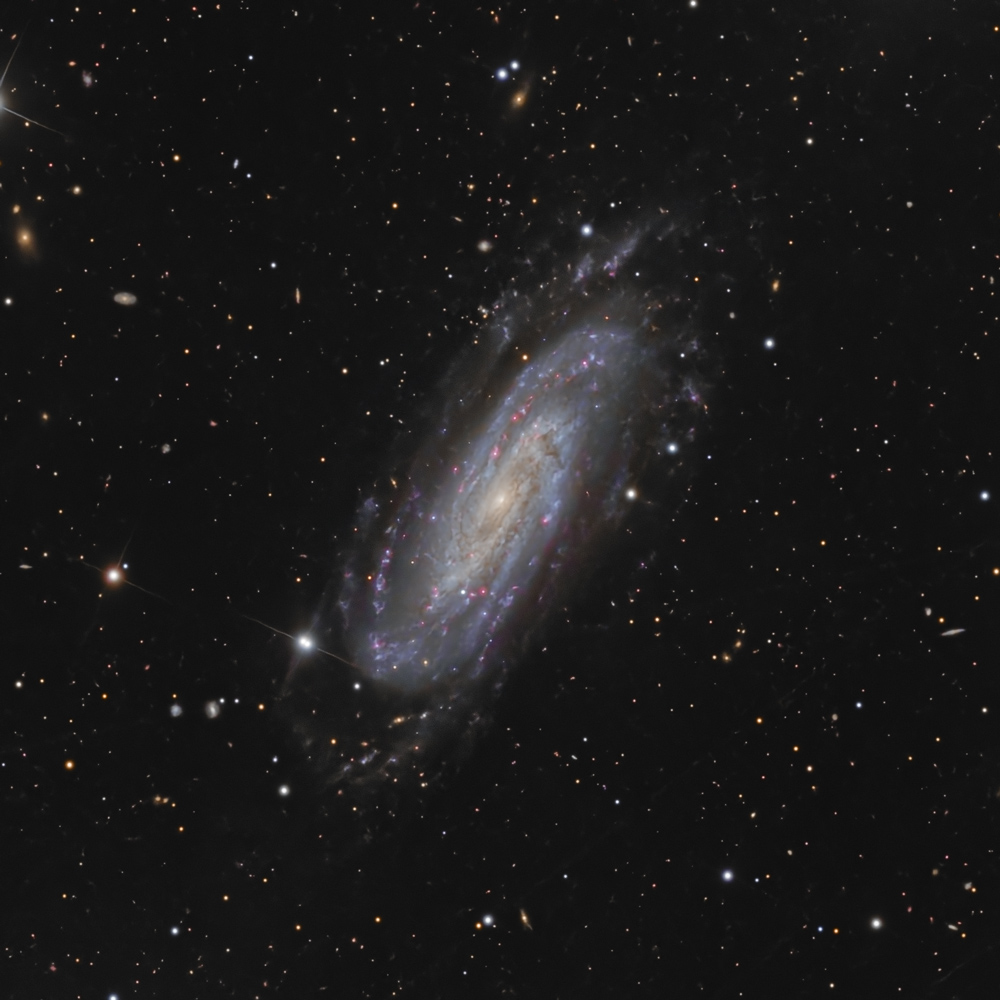
NGC 3198
NGC 3198
Barred Spiral Galaxy in Ursa Major

Click here for uncropped versions: 40% uncropped (1374x1374) 65% uncropped (2233x2233 100% uncropped (3436x3436)


NGC 3198 is a barred spiral galaxy, visually located within the constellation Ursa Major. It is thought to be about 122,000 light years across (perhaps slightly larger than our Milky Way galaxy; a large galaxy), and about 47 million light years away from us. It presents to us quite tilted, so that it looks elliptical.

Interestingly, studies of this pretty galaxy helped in the acceptance of dark matter as a real thing. There apparently is a lot of free hydrogen in this galaxy, extending far beyond the stars. The rotation rate of this gas was best explained by the existence of a great deal of dark matter in the galaxy (it is thought that 75% - 85% of the total mass of this galaxy is dark matter).

It is often the case that, when pointing a telescope with a camera mounted on it toward the sky (especially outside of the plane of the Milky Way), we see LOTS of tiny (meaning far, far away) background galaxies. This photo is a vivid illustration of that (especially the high resolution, uncropped, version).


Technical Information:

HaLRGB: 580:820:240:270:340 (a total of over 32 hours of light-frame exposure time); here's a chart showing the various subexposures I used in the image:

Hydrogen Alpha: 29 twenty-minute images Luminance: 38 twenty-minute and 20 three-minute
Red: 16 fifteen-minute
Green: 18 fifteen-minute
Blue: 17 twenty-minute
The luminance layer is a HDR blend of the 20-minute images and the three-minute images. The red channel is a blend of the red data and the Ha data. The green channel is made up entirely of the green data. The blue channel is made up entirely of the blue data.


Equipment: RC Optical Systems 14.5 inch Ritchey-Chrétien carbon fiber truss telescope, with ion-milled optics and RCOS field flattener, at about f/9, and an SBIG STX-16803 with internal filter wheel (SBIG filter set), guided by an SBIG STX Guider, all riding on a Bisque Paramount ME German Equatorial Mount.

Image Acquisition/Camera Control: Maxim DL, controlled with ACP Expert/Scheduler, working in concert with TheSky X.

Processing: All images calibrated (darks, bias and sky flats), aligned, and combined (using NormalizeScaleGradient) in Pixinsight. Color combine in Pixinsight. Ha data blended into the luminance and color layers in Pixinsight. Some finish work (NoiseXTerminator; BlurXTerminator, color calibration, gradient removal, and weaving the Ha data into the red channel, done in Pixinsight; some finish work (LRGB combination, saturation adjustment) was done in Photoshop CC.

Location: Data acquired remotely from Sierra Remote Observatories, Auberry, California, USA.

Date: Images taken on many nights during January and February of 2026. Image posted August 18, 2026.

Date: Image scale of full-resolution image: 0.56 arcseconds per pixel.

Seeing: Variable.

CCD Chip temperature: -25C

Copyright 2026 Mark de Regt