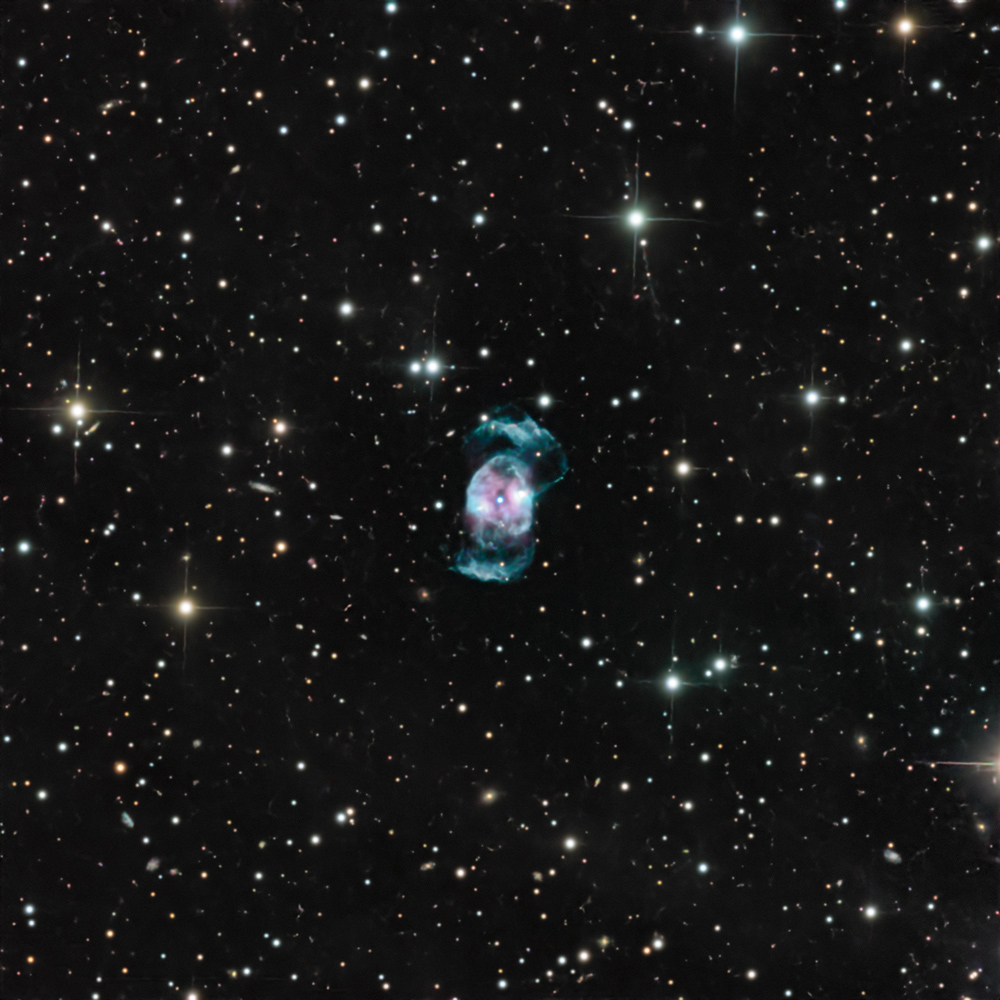
NGC 2371 and NGC 2372: This is a small (about 2.6 arcminutes across the semi-major axis; about three times the angular size as Jupiter at its closest to earth) planetary nebula
in the constellation Gemini. It is not very bright (overall magnitude of about 13), but the central part is bright enough to be seen through a 6" telescope); the wide dynamic range of the
object makes it a bit of a challenge to process.
It oddly carries two entries in the NGC catalog, NGC 2371 and NGC 2372, probably because, visually, it seems to be two separate objects.
A "planetary nebula" (so called because the astronomer who first identified them as nebulae noted the color was similar to the then recently-discovered Neptune) is a structure of gas resulting
from the death throes of a star about the size of our sun, when it runs out of fusable material; the color is the result of the gas being ionized by the remnant of the star, a white dwarf
(ionized oxygen is the dominant emission in this planetary nebulae, giving off the characteristic blue-green color; there also is some ionized hydrogen, which shows a reddish color).
It is estimated to be approximately 4400 light years from earth, which would give it a diameter of about 3 light years.
Copyright 2025, 2026 Mark de Regt