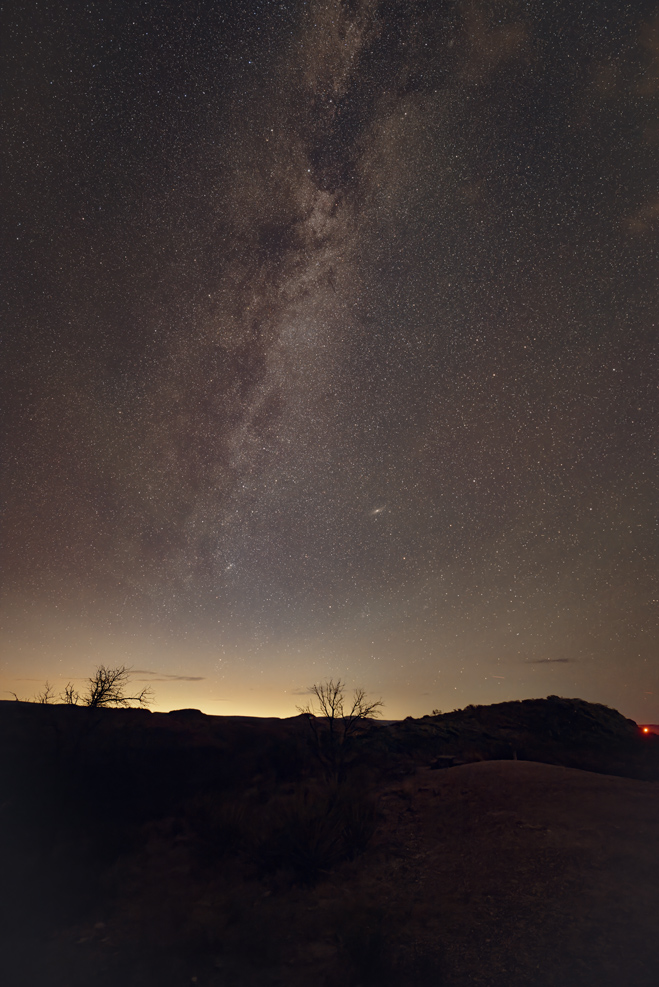
Milky Way: Planet Earth is located within the Milky Way galaxy, a fairly large galaxy (as galaxies go) at over 100,000 light years across.
From a very dark site, the structure shown in this photo is very apparent to the naked eye; unfortunately, there are few dark sites left near any populations. Since the Milky Way is no longer visible from our
yeard, we went down to Texas to photograph it, during the new moon time in September of 2026. We chose the area of Ft. Davis, Texas, because there is a professional observatory complex nearby, so we figured it
would have a VERY dark sky; we were not disappointed.
It takes very dark sky to see that the Milky Way goes all the way across the sky. This is taken pointing north; this is the "other end" of the Milky Way, compared to the other Milky Way images I have posted.
It is fainter than that seen in the southern sky, from the northern hemisphere, because the core of the Milky Way, shows in the southern sky, and it is much more dramatic than the outer parts, as seen from Earth.
This was taken from Davis Mountains State Park, near Ft. Davis, Texas. I know where the large, nearby spiral galaxy M31 is in the sky, and I was curious if I could capture it with such a short focal
length lens. I did! It is the elongated blob to the right of center in this image.
This image has much more sky glow than the images taken from the same place looking south. The only likely culprit is Pecos, quite far away.
The mix of dark brown, light brown and very light areas within the Milky Way reflects the fact that earth is within the disc of the galaxy, so we are, essentailly, looking at the
galaxy edge on. Click here to see a view from earth of a fairly similar galaxy to ours, showing the dust lanes as part of the galaxy disc.
Copyright Mark de Regt, 2026