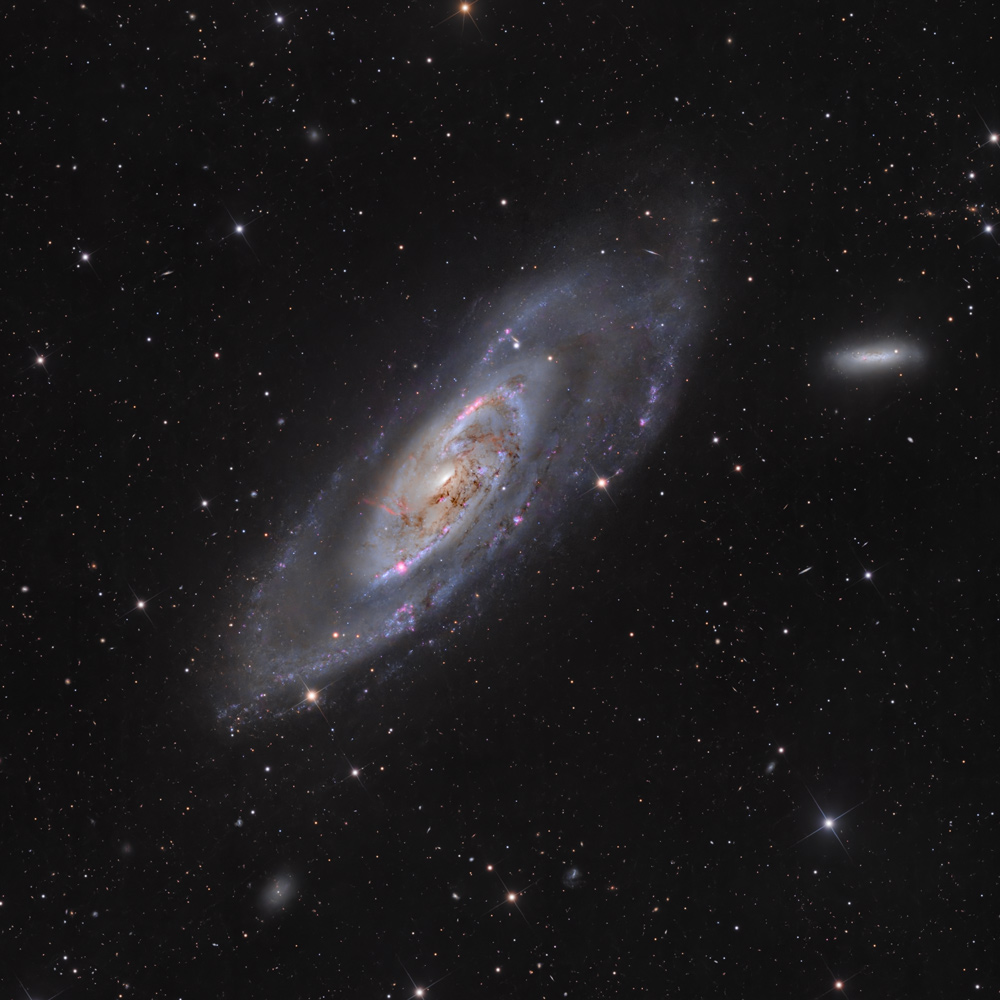
M108 is a intermediate spiral galaxy, seen at a sharp angle to us,
located about 24 million light years from us. The pink regions are ionized hydrogen gas, indicating star-forming regions.
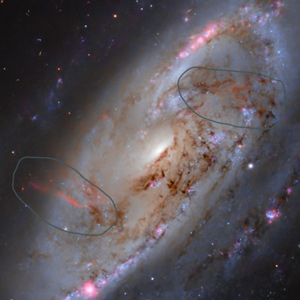
An unusual feature in this striking galaxy is the set of gaseous arms, emanating from the central supermassive black hole. They are difficult to see in this image,
appearing only as red streaks, fairly near to the center, on opposite sides of the center. These are super-heated gas, thought to be related to the action of the
central black hole. Below is a little cutout of the central part of the galaxy, with the two anomalous arms circled.
The dominant blue color in the disk is from energetic young stars being formed in the arms of the galaxy; the yellow is from a combination of older stars inhabiting
the core, and light from starburst happening there. The rust-colored stuff is dust swirling around the core of the galaxy. To the right of M106 in this photo is NGC 4248, a dwarf
galaxy that is a satellite of M106. Below the bottom point of M106 is PGC 39615, another dwarf galaxy that is a satellite of M106. The entire field of the uncropped photo is about
the same width as a full moon. As is often the case, the field in the uncropped images is littered with smaller (meaning far more distant) galaxies; I always like seeing how many
galaxies there are in our universe! A special bonus is the distant galaxy cluster ClG J1217+4730, just above NGC 4248 in my photo, and just to the right of the upper corner of
M106 (more easily seen in the full resolution, uncropped photo linked above); it is the collection of deep yellow dots, many of which are elongated, located about 3.2 billion light
years from us.
M106 is a large galaxy, with a diameter of about 135,000 light years (a bit larger than our Milky Way).
Copyright 2026 Mark de Regt