HOME
IC 405
IC 405
Sh2-229
Flaming Star Nebula
Emission and Reflection Nebula in Auriga
Click here for higher-resolution versions: 40% (1624x1622) 65%
(2640x2637) 100% (4061x4056)
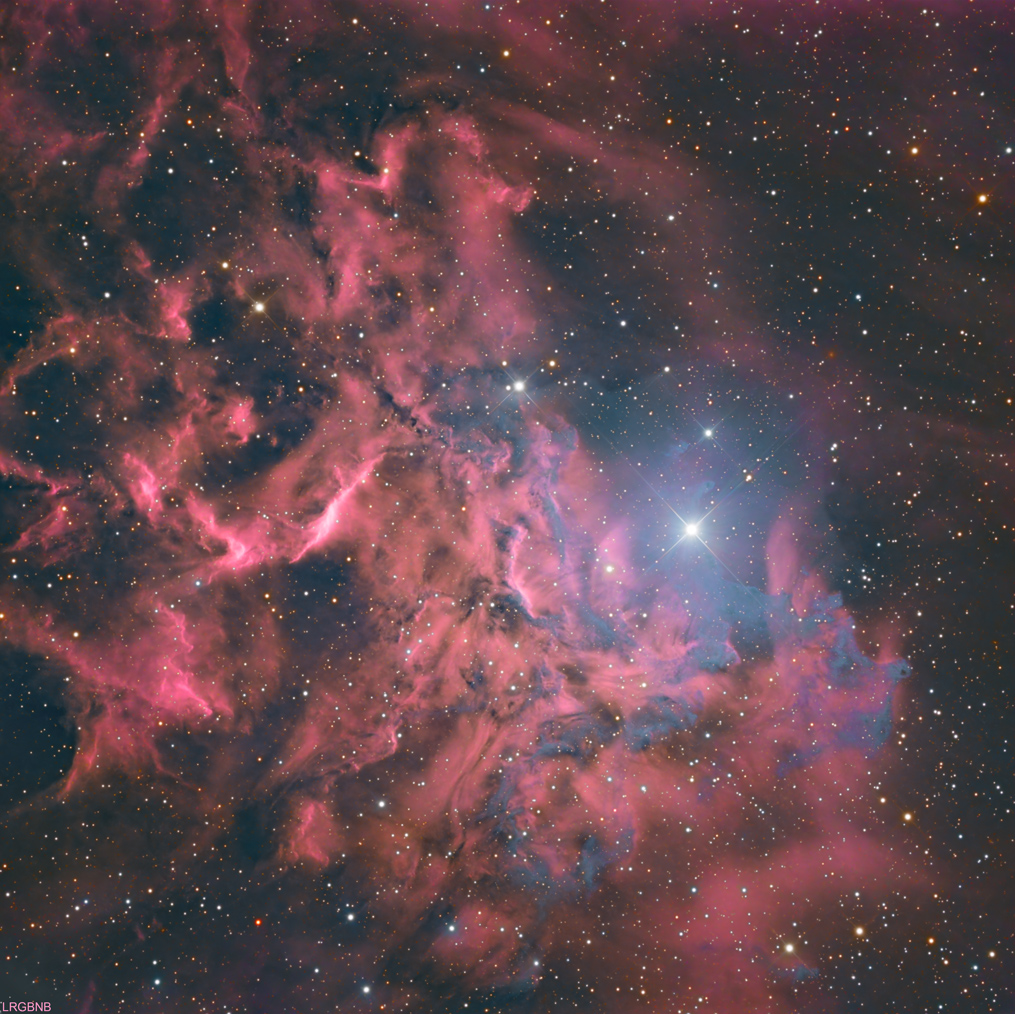 Click on image to cycle through the four versions of the image (described below and labeled on the lower left corner of each image)
IC 405 is a bright emission (red part) and reflection nebula (blue stuff), visually located in the constellation Auriga; it is part of a much larger star-forming region. The
nebula, itself a star-forming region, is predominantly red in the true-color versions, because (i) ionized hydrogen emits in the red part of the spectrum; (ii) the dominant emissions captured in this photo are
from hydrogen being ionized (stripped of its electron) by the energetic young stars being formed inside the nebula. Unusually, the emissions from ionized sulfur, which are red in color,
are quite strong, and ionized oxygen (blue-green in color) quite weak. The ionized sulfur does not show up in the true-color versions, since it's red like the dominant ionized hydrogen, but it
does show up strongly in the SHO version.
The blue streaks are where the light from the very bright blue star to the right of center of this photo is reflected off of dust. Interestingly (to me, at least ;) ), this dust obscures the light
from the emission nebula behind it, with the result that, where the blue streaks are in the true-color images shows up as dark streaks in the SHO and pure Ha versions.
The field is thought to be about 15,000 light years from Earth; at that distance, this field is about 166 light years across. Visually, this field is somewhat larger that the width of a
full moon (although very dim by comparison).
This nebula is quite near, visually, to the IC 410, which I also imaged recently; click here to see that beautiful nebula.
I have presented this object in four different formats; I like each one in its own way. This is the order in which they appear as you cycle through (by repeatedly clicking on the photo, waiting for
each to download; each is labeled in the lower left corner), starting with a reddish version:
(i) A true-color version (the top photo in the stack, labeled "LRGBNB" in the bottom left), with the color created by imaging through red, green and blue filters
(with a significant amount of Ha and OIII data blended into various channels, in varying percentages; Ha emissions are in the red part of the spectrum, and OIII emissions are blue-green, so I have
blended Ha into the luminance layer and the red channel, and OIII into the green and blue channels).
(ii) A true-color version (the second photo in the stack, labeled "LRGB" in the bottom left), with the color created by imaging through red, green and blue filters
only (no Ha or OIII data included). It is interesting to see how much the addition of the Ha and OIII increases the detail, but I like the more-colorful stars in this version, and the more
natural-looking reflection components.
(iii) A version in the traditional Hubble palette (third in the stack, labeled "SHO" in the bottom left); a lot of the Hubble photos, including and especially the
famous "Pillars of Creation," are made with this set of filters, since it's a useful set for scientists to see what's actually happening), which shows SII emissions as red, Ha emissions as green,
and OIII emissions as blue. Because Ha emissions so dominate this nebula, I have significantly de-emphasized them in this rendering . The OIII emissions on this object are very dim, and add only near
the bright star; the SII emissions in this nebula are often in the same place as the Ha emissions, which produces the yellowish color. This form of combining results in magenta-colored stars, which I have significantly desaturated.
(iv) A version which is only the grayscale Ha image.
These are fourof the most frequent ways images of emission nebulae are likely to be presented, so I thought it would be fun to include all of them, to be able to compare and contrast the different presentations.
Technical Information:
Ha:OIII:SII:L:R:G:B: 630:720:720:615:180:180:240 (a total of almost 55 hours of light-frame exposure time); here's a chart showing
the various subexposures I used in the image:
Hydrogen Alpha: 21 thirty-minute
Oxygen III: 24 thirty-minute
Sulfur II: 24 thirty-minute
Luminance: 37 fifteen-minute, and 20 three-minute
Red: 12 fifteen-minute
Green: 12 fifteen-minute
Blue: 12 twenty-minute
The luminance layer is a mix of the luminance-filtered images and the Ha-filtered images; the red channel is a mix of the red-filtered images
and the Ha-filtered images; the green channel is a mix of the green-filtered images and the OIII-filtered images; the blue channel is a mix of the blue-filtered images and the OIII-filtered images. The
SHO versions also use the Ha, OIII and SII data.
Equipment: RC Optical Systems 14.5 inch Ritchey-Chrétien carbon fiber truss telescope, with ion-milled optics and RCOS field flattener, at about f/9, and an SBIG STX-16803 camera with internal filter wheel (SBIG filter set), guided by an SBIG STX guider, all riding on a Bisque Paramount ME German Equatorial Mount.
Image Acquisition/Camera Control: Maxim DL, controlled with ACP Expert/Scheduler, working in concert with TheSky X.
Processing: All images calibrated (darks, bias and sky flats), aligned, combined and cropped in Pixinsight. Color combine in Pixinsight. Some finish work (background neutralization,
color calibration, noise reduction with NoiseXTerminator; deconvolution using BlurXterminator, HDR combine of the luminance data) done in Pixinsight; some cleanup finish work was done in Photoshop CC.
Location: Data acquired remotely from Sierra Remote Observatories, Auberry, California, USA.
Date: Images taken on many nights in December of 2025 and January and February of 2026. Image posted June 29, 2026.
Date: Image scale of full-resolution image: 0.56 arcseconds per pixel.
Seeing: Mediocre to poor
CCD Chip temperature: -25C
Copyright 2025, 2026 Mark de Regt