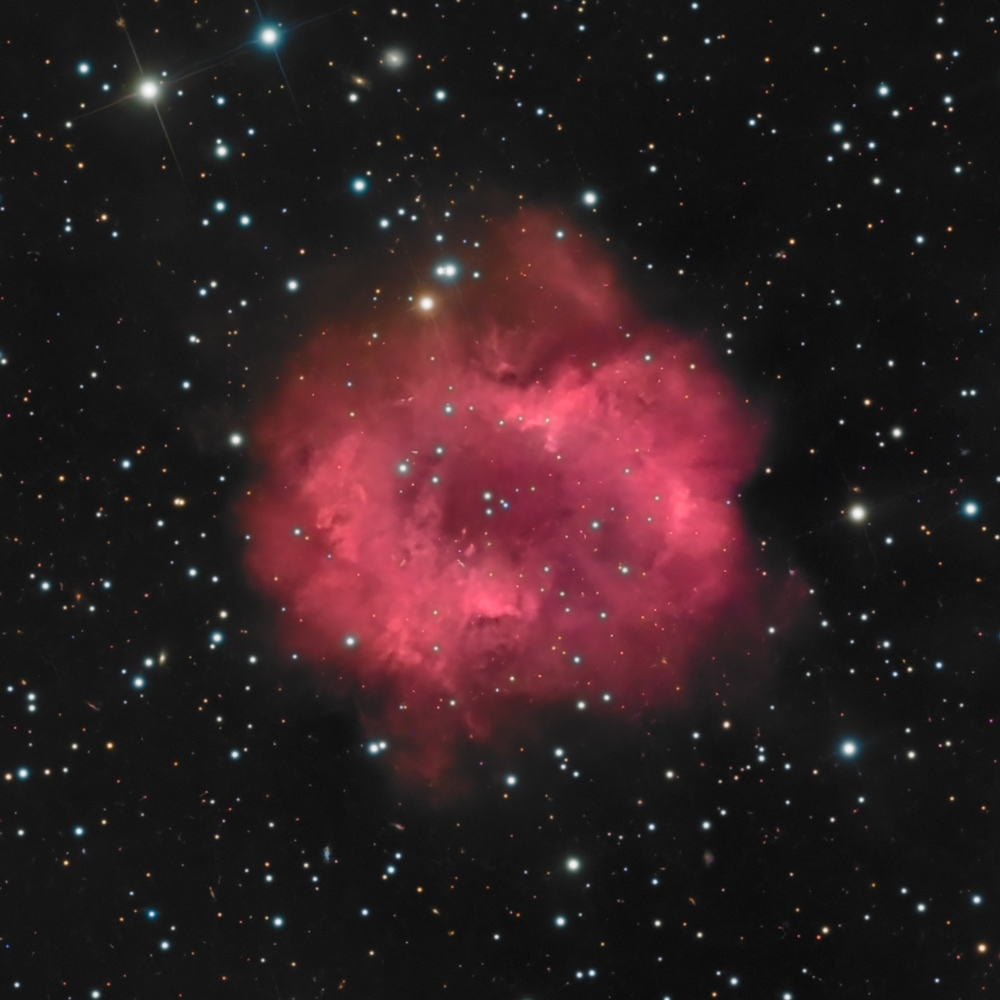
Abell 24 is a very dim planetary nebula
in the constellation Canis Minor. Its angular size is about 8 arcminutes across, about a quarter of the angular size of the full moon. It is extremely dim; as planetary nebulae age, their gas
continues to expand, eventually dissipating. Scientists figure that this planetary nebula started forming about 20,000 light years ago; it is now about four light years across. Technical Information: Ha:OIII:L:R:G:B: 690:600:564:240:180:240 (a total of almost 42 hours of light-frame exposure time). Here's a chart showing the various subexposures I took: Equipment: RC Optical Systems 14.5 inch Ritchey-Chretien carbon fiber truss telescope, with ion-milled optics and RCOS field flattener, at about f/9, and an SBIG STX-16803 camera with
internal filter wheel (SBIG filter set), guided by an SBIG STX guider, all riding on a Bisque Paramount ME German Equatorial Mount. Image Acquisition/Camera Control: Maxim DL, controlled with ACP Expert/Scheduler, working in concert with TheSky X. Processing: All images calibrated (darks, bias and sky flats), aligned, combined and cropped in Pixinsight. Color combine in Pixinsight. Some HDR processing was done in
Pixinsight. Some finish work (background neutralization, color calibration, NoiseXTerminator and BlurXTerminator) done in Pixinsight; some cleanup finish work was done in Photoshop CC. Location: Data acquired remotely from Sierra Remote Observatories, Auberry, California, USA. Date: Images taken on many nights in January and February 2026. Image posted August 29, 2026. Date: Image scale of full-resolution image: 0.56 arcseconds per pixel. Seeing: Quite variable; sometimes poor CCD Chip temperature: -25C Copyright 2026
Mark de Regt
The color is the result of the gas being ionized by the remnant of the star, a white dwarf (ionized hydrogen, which emits in the red part of the spectrum, is the dominant emission in this
planetary nebulae; there also is some ionized oxygen, which perhaps adds a slight bluish tinge to the inner part of the nebula).
This planetary nebula is unusual in that it looks more like a standard emission nebula than most planetary nebulae (which usually show a structure showing its origin as coming from a star). For
instance, it has a strong resemblance to the iconic emission nebula, the Rosette Nebula.
At the right edge of the uncropped images is a very bright (mag 6) yellow star; at the bottom edge of the uncropped images is another mag 6 star (this one is blue). Fortunately, both were far enough from
the nebula that they didn't make things difficult.
Luminance: 33 fifteen-minute and 23 three-minute
Red: 16 fifteen-minute
Green: 12 fifteen-minute
Blue: 12 twenty-minute
Ha: 23 thirty-minute
OIII: 20 thirty-minute
Luminance layer is a blend of the luminance-filtered images and the Ha-filtered images.
Red is a blend of the red-filtered images and the Ha-filtered images.
Green is a blend of the green-filtered images and the OIII-filtered images.
Blue is a blend of the blue-filtered images and the OIII-filtered images.